Showing posts with label Boston. Show all posts

Thursday, March 17, 2016

Who Was "Saint Patrick"? Should a Christian Observe Saint Patrick's Day?

From http://el-paso.ucg.org/ or call 1-888-886-8632. Please follow this site here.

Let’s start with what most people think they know. We have been told that Patrick was a Catholic monk who brought the Trinity doctrine to the people of Ireland. And along the way he drove all the snakes from the Emerald Isle. He became so renowned that the Catholic Church made him a “saint.” None of that is true!

Patrick was Scottish!

Patrick’s given name was actually Maewyn Succat (or Sucat). He took the name Patrick most likely because of the area he was from in Scotland. That’s right, Patrick was Scottish, not Irish! Here’s what Patrick said himself of his background: “ I, Patrick…had Calpornius  for my father, a deacon, a son of the late Potitus, the presbyter, who dwelt in the village of Banavan…I was captured. I was almost sixteen years of age…and taken to Ireland in captivity with many thousand men” (William Cathcart, D. D., The Ancient British and Irish Churches , p.127).
Patrick labored for six years as a slave until he managed to escape back to his native Scotland around A.D. 376. He believed he had a calling from God, however, to go back to Ireland to teach God’s Word to the people there. The Catholic Church, while having had an impact in England and later Scotland, did not have a significant foothold in Ireland until the 12th century. They didn’t even acknowledge Patrick for about 200 years after his death.  Patrick was connected to what is known as the Celtic Church. It was very much opposed to what was taught in the Roman Catholic Church.

Patrick did not follow Roman Catholic doctrine

While we have little of Patrick’s history and teaching written by himself, what’s taught about Patrick now didn’t surface until about 500 years after his death. It was the Catholic priest Jocelyn, writing around A.D. 1130 who wrote most extensively about Patrick. He ignored much of what was known then about Patrick and inserted a Catholic background into Patrick’s story. Patrick never wrote about a connection to Rome or popes or that his authority came from there. So if Patrick wasn’t Roman Catholic, what did he teach?
In A.D. 596 Pope Gregory sent a group of monks to England to try and bring the Celtic Church under the authority of Rome. However, the Celts refused to acknowledge Gregory’s authority and rejected the teachings of the Roman Church. In Ireland the monks found that the Celtic Church permitted their priests to marry. They also practiced baptism by full immersion in water. The Celtic Church also rejected the doctrine of (papal) infallibility and veneration, transubstantiation, the confessional, the Mass, relic worship, image adoration and the primacy of Peter ( Truth Triumphant , by B.G. Wilkinson, pg. 108). The latter list is of specific Roman Catholic doctrines that the Celtic Church knew were not taught in the Scriptures.

Patrick observed the Saturday Sabbath, Passover and rejected the Trinity doctrine

Patrick also rejected the merging of church and state (a main teaching of Catholicism). He believed and taught the same as Jesus in John 18:36 that God’s Kingdom is not of this world. The Celtic Church had local ecclesiastical councils and kept Saturday as a day of rest , (A.C. Flick, The Rise of Medieval Church, pp. 236-327). In this matter of a Saturday (Sabbath) rest, Dr. James C. Moffatt wrote that, “They [the Celtic churches] obeyed the fourth commandment [the Sabbath commandment] literally upon the seventh day of the week” ( The Church in Scotland , pg. 140).
Patrick (and the Celtic Church) observed the other “festivals of the Eternal” (Leviticus 23), believed human beings were mortal (that is rejected the teaching of an immortal soul and the doctrine of going to heaven or hell), rejected the Trinity doctrine, followed the food laws of Leviticus 11, refused veneration of “saints” or worship of Mary, and believed that only Jesus Christ is our mediator (Leslie Hardinge, The Celtic Church in Britain  ; B.G. Wilkinson, Truth Triumphant ).
The Celtic Church had a long history before the Catholic Church pushed deeper into England, Scotland and Ireland. Celtic writings speak of individuals coming from Asia Minor who brought with them the doctrines they received from John, Paul, Philip and other apostles of Jesus. A Catholic “father,” Bede, (who lived in the mid 700s A.D.) who wrote about the Celtic Church: “They ignorantly refuse to observe our Easter [Pascha, or Passover] on which Christ was sacrificed, arguing that it should be observed with the Hebrew Passover on the fourteenth of the moon” (Bede, Historia Ecclesiastica ).

Is Saint Patrick’s Day in the Bible?

Saint Patrick’s Day is not a biblical holiday or Holy Day. And, as it is currently celebrated, St. Patrick’s Day actually has nothing to do with the historical man Patrick. Many “Christian” holidays are a mixture of truth and error. Because of this, most people don’t really know the history or purpose of the day. We encourage you to read what God said in the Bible to know which Holy Days He made and who He said are saints. The United Church of God traces its origins to the Church that Jesus founded in the early first century. We follow the same teachings, doctrines and practices established then, and believe our commission is to proclaim the gospel of the coming Kingdom of God to all the world as a witness and teach all nations to observe what Christ commanded.
It appears that Patrick believed these same teachings. We encourage you to read the online Bible study aids, Fundamental Beliefs of the United Church of God and The Church Jesus Built  to learn more about what individuals like Patrick taught and what we teach from Scripture. From our best historical understanding, the Patrick you didn’t know lived a life according to the Bible, rather than human traditions. You can too.

You might also be interested in...

Wednesday, March 16, 2016

St. Patrick & St. Patrick's Day

From http://el-paso.ucg.org/ or call 1-888-886-8632. Please follow this site here.

Theologian and historian James Moffatt said, “So much legend and fiction has been written about him that one is almost led to believe that there were two individuals—the real Patrick and the fictitious Patrick” ( The Church in Scotland , 1882, p. 140).
There are few hard facts about Patrick's life, but we can draw some reasonable conclusions from what we do know.
Patrick is credited with establishing the Roman Catholic Church throughout Ireland. But does history match tradition? Moffatt commented, “He should not be placed where certain historians seem determined to assign him … He was in no way connected with the type of Christianity which developed in Italy” (ibid).
As it turns out, Patrick probably wasn't even Catholic! His belief system was evidently quite different than that of continental Europe.
It's probable that Patrick even honored God's seventh day Sabbath! “It seems to have been customary in the Celtic churches of early times, in Ireland as well as Scotland, to keep Saturday, the Jewish Sabbath, as a day of rest from labor” (ibid).
Other historical records and Patrick's own writings reveal him to have been closer to biblical instruction than to traditional Christianity. Part of the Bible's teaching includes rejecting the use of pagan practices in the worship of the true God (Deuteronomy 12:29-32).
The real Patrick likely wouldn't even have approved of observing his own namesake holiday! This holiday on March 17 was supposedly to commemorate his death, but that date was in fact the time of the Roman Bacchanalia—celebrating the god of wine and partying. It seems the pagan party goes on in another guise. Bear that in mind when March 17 comes around. Forget the leprechauns, and put God first!
Read the related article “Do You Feel Lucky Today? “

You might also be interested in...

Tuesday, October 13, 2015

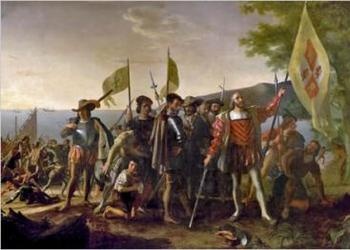
Christopher Columbus and Jesus Christ

From http://el-paso.ucg.org/ or call 1-888-886-8632. Please follow this site here.

Christopher Columbus and Jesus Christ

Login or Create an Account

With a UCG.org account you will be able to save items to read and study later!
Sign In | Sign Up
×
Notice what he later wrote in describing his efforts to find a new route to India:
“It was the Lord who put into my mind (I could feel his hand upon me) the fact that it would be possible to sail from here to the Indies. All who heard of my project rejected it with laughter, ridiculing me. There is no question that the inspiration was from the Holy Spirit . . .
“For the execution of the journey to the Indies, I did not make use of intelligence, mathematics or maps. It is simply the fulfillment of what Isaiah had prophesied . . . No one should fear to undertake any task in the name of our Savior if it is just and if the intention is purely for His holy service” (quoted by Bob Gingrich, Founding Fathers vs. History Revisionists: In Their Own Words, 2008, p. 17).

Wednesday, June 17, 2015

Islamic Caliphate Declared What Does It Mean?

From http://el-paso.ucg.org/ or call 1-888-886-8632. Please follow this site here.

Islamic Caliphate Declared

What Does It Mean?

Login or Create an Account

With a UCG.org account you will be able to save items to read and study later!
Sign In | Sign Up
×
On the first day of the Muslim holy month of Ramadan this year, June 29, 2014, the al-Qaeda breakaway group ISIS or ISIL, the Islamic State of Iraq and al-Sham (i.e., Greater Syria or the Levant)—which has seized vast tracts of Iraq and much of northern Syria—formally declared the creation of an Islamic transnational state, or caliphate. In doing so, the group changed its name to just the Islamic State (IS), as the caliphate is to rule Muslims the world over.
The group's chief, who's borne the pseudonym Abu Bakr al-Baghdadi, was declared to be the new caliph or leader of the Islamic State—now Caliph Ibrahim. A spokesman for the group “called on those living in the areas under the organization's control to swear allegiance to al-Baghdadi and support him. 'The legality of all emirates, groups, states and organizations becomes null by the expansion of the caliph's authority and the arrival of its troops to their areas,' [the spokesman] said” (“ISIS Declares Creation of Mideast Caliphate Across Iraq and Syria,” CBS News, June 29, 2014).
Baghdadi then called for Muslims to rally to his new state and to conquering the Christian West, saying: “Those who can immigrate to the Islamic State should immigrate, as immigration to the house of Islam is a duty … Rush O Muslims to your state … This is my advice to you. If you hold to it you will conquer Rome and own the world, if Allah wills” (quoted by Damien McElroy, “Rome Will Be Conquered Next, Says Leader of 'Islamic State,'” The Telegraph, July 1, 2014).

Longtime desire to reestablish the caliphate

The desire to reestablish the caliphate is driven by the goal of joining all Muslims under a single rule—as in the days of Islam's founder, Muhammad, and his immediate successors or caliphs in the seventh century. Under that rule everyone is to strictly adhere to sharia—Islamic law and jurisprudence—and follow the way of jihad or holy war to conquer the globe.
The caliphate was declared by a succession of Muslim empires over the centuries, the latest being that of the Ottoman Turks, which ended with World War I. Yet these are viewed as corrupt, and the desire of the Islamists today is to restore the initial “righteous” caliphate.
Islamist terror groups the world over, including Hamas, al-Qaeda, Islamic Jihad, the Taliban, the Muslim Brotherhood, etc., “all profess the revival of the caliphate, the regime that was installed by Muhammed's righteous successors, the caliphs, and has become the iconic model to be emulated by all future generations of Muslims” (Raphael Israeli, From Arab Spring to Islamic Winter, 2013, p. xiii). (See “20-Year Plan for a Global Caliphate “.)
During and after the Arab Spring uprisings of 2011-2012, momentum seemed to be building toward the formation of a caliphate, particularly with the ascendance of a Muslim Brotherhood candidate, Mohamed Morsi, to the presidency of Egypt. Yet with the military coup in Egypt last year that ousted Morsi and instigated a major crackdown against the Brotherhood, the momentum toward a caliphate appeared to have stalled.
But now, with millions of Islamic extremists across the Middle East still pressing for that Muslim dream, where one door closes another opens (although the door in Egypt is by no means truly closed, as the population there remains predominantly Islamist).
So what are we to make of this new development?
A number of Islamist groups and prominent clerics are not supportive of the declaration of the Islamic State, as it's viewed as premature and a cause for infighting between Muslim groups and states. But significant support has come in from far quarters. No doubt a great deal of blood will be shed over this among Muslims and between Muslims and the non-Islamic world.
In considering the matter we should ask: How did the new Islamic State come to be, and what are its prospects for success as a revived caliphate? Or might another group receive wider acceptance in the role? And does Bible prophecy tell us anything regarding such developments?

The rise of ISIS and Abu Bakr al-Baghdadi

The al-Qaeda contingent in Iraq, headed up by Abu Musab al-Zarqawi in the mid-2000s, went through several incarnations before eventually becoming the Islamic State of Iraq, or ISI, which came to be headed up by Abu Bakr al-Baghdadi in 2010, when American forces were withdrawing from the country.
The group's extreme brutality and killing of fellow Muslims created a divide between it and al-Qaeda's international leadership, which considered Zarqawi and his followers too extreme and criticized them for alienating people from the Islamist cause.
Furthermore, Osama bin Laden's successor Ayman al-Zawahiri maintained, as do many Islamist scholars now opposed to the current caliphate declaration, that a caliphate must follow the purification of the wider Muslim world, being then based on the consent of the public.
But, as Margaret Coker explains in The Wall Street Journal, Baghdadi and his supporters “reject this doctrine of an evolving religious and social consensus. They believe instead that a pure Islamic regime can be more swiftly imposed by force” (“The New Jihad,” July 11).
And in fact, this is the way the caliphate has been imposed in past centuries.
The struggle came to a head in April 2013, when Baghdadi declared a takeover of the Nusra Front, an al-Qaeda-linked rebel militia fighting against President Bashar al-Assad in Syria, stating that it would be merged with ISI to form ISIS. The Nusra Front rejected the takeover bid and Zawahiri ordered Baghdadi to leave Syria and maintain operations in Iraq. But in a huge affront to al-Qaeda, Baghdadi said he would follow Allah instead and maintained the ISIS merger, whereupon Zawahiri formally disowned the group.
ISIS went on to take over sizable parts of Syria and Iraq, sweeping through in a brutal blitzkrieg. It took to social media to demoralize resistance by displaying its extreme brutality. This tactic helped ISIS to wrest control of the large city of Mosul and its environs in June of this year when the Iraqi army had to retreat due to massive numbers of desertions.
The conquest of this area put huge amounts of advanced U.S. weaponry into the hands of ISIS, as well as hundreds of millions of dollars looted from banks—making it far wealthier than al-Qaeda ever was. And with U.S. forces now gone from Iraq, the new Islamic State has a great deal of room to maneuver. It thus seems poised to change the Middle East, if not the greater world scene, in a dramatic fashion.

Striking fear in the hearts and minds of opponents

Joseph Farah, editor in chief of WND (the former WorldNetDaily), commented prior to the caliphate announcement: “Do I expect to see ISIS conquer the Middle East, North Africa, part of Europe and Asia in the 21st century? No, I don't. But I do expect to see enormous carnage and destruction and bloodshed as a result of this movement—far more, perhaps, than most other analysts project. There is a ferocity to ISIS that makes even al-Qaida uncomfortable. It has already captured more wealth and armaments, including chemical weapons, than all but a handful of countries in the world possess …
“Brutality difficult for Westerners to even imagine is the modus operandi of ISIS. It calls for a scorched-earth policy against its enemies—which includes Christians, Shiites, Alawites, Jews, non-believers and all non-Sunnis. ISIS leadership advocates and practices barbarism designed to strike fear into the hearts and minds of its opponents and anyone who doesn't stand with them in their strict Shariah Sunni code.
“Already the ISIS marauders have crucified victims, beheaded them and conducted mass executions of Iraqi soldiers and civilians. No atrocity is beneath them” (“ISIS Rising—What It Portends,” June 23, 2014).
Farah compares the speed of their conquest with the original march of Islam and even Alexander the Great. “The success of campaigns like that requires that superior forces faint in fear of the coming hordes. You can see it's working already in Iraq” (ibid.).

Is the new caliphate viable?

BBC security correspondent Frank Gardner gave a helpful analysis of the situation, dealing with the question of whether ISIS can maintain its rule and viability: “Analysts point out that seizing territory is one thing, governing it is quite another” (“'Jihadistan': Can Isis Militants Rule Seized Territory?” July 8, 2014).
Despite its remarkable military success in the wake of its psychological warfare, “Isis has effectively been 'punching above its weight,' to use a boxing analogy,” its numbers of between 10,000 and 15,000 fighters being low compared to competing forces. Gardner quotes a pan-Arab newspaper stating, “Isis' ability to control lands has been based on deals with local militants willing to do the 'ruling' for them.”
He further notes that Baghdadi and his followers do not seem, on one hand, to have learned from the mistakes of their predecessors under Zarqawi in Iraq in their brutal treatment of the populace, which failed to win hearts and minds. Regarding ISIS, “stories abound of harsh punishments imposed for the slightest of offences, women being confined to the home, public crucifixions, kidnappings and extortionate levies imposed on businesses …”
While Gardner on the other hand points out ISIS taking care of municipal needs like garbage collection, the mask of public service has since come off.
Gardner further states: “To succeed as a viable state, let alone as a transnational 'caliphate,' Isis will need access to oil and water.” And ISIS/IS now has both, controlling refineries and major dams in Syria and Iraq.
Gardner argues that the new Islamic state is not going away: “The only force capable of permanently ejecting Isis will be the tribes in those regions [they rule], and they have little incentive to do so while the Syrian civil war rages on …
“Which leaves the prospect of a violent, extremist, well-armed, well-funded and religiously intolerant militia becoming a permanent part of the Middle East landscape, a sort of de facto 'jihadistan.'” And, he notes, like Afghanistan it would also be a springboard for increased attacks against neighboring countries and the Western world.

Several key advantages and others to carry on the cause

In spite of the denunciation received from some Islamic scholars and disapproval from al-Qaeda and other jihadist organizations, this group nevertheless has much going for it in the Muslim world. One advantage is in the very declaration of the caliphate, as it's unlikely that a number of claimants would start declaring their own since that would minimize the whole idea of the pan-Islamic state.
Furthermore, the fact that ISIS/IS is actually carrying out major exploits and making massive gains, with the caliphate proclamation on top of that, can capture the imagination of the younger generation of jihadists.
As noted in Newsweek:“The brutal attacks of 9/11 were almost 13 years ago; many of the jihadist fighters on the front lines now were children then. They have grown up seeing Al-Qaeda on the defensive, with few successes of its own, while ISIS has stunned the world with its victories in Syria and Iraq” (Kurt Eichenwald, “Iraq's ISIS Is Eclipsing Al-Qaeda, Especially With Young Jihadists,” July 7, 2014).
Indeed, at his site Intelwire author J.M. Berger points out regarding al-Qaeda that “one of its few practical remaining plays would be to squander the entirety of whatever resources it has left on an attack against the West, in the hopes of regaining its reputation” (“A New Day for ISIS,” June 11). That should serve as a stark warning of great danger for the world even in the short term.
Since the proclamation of the new Islamic State, it has seen increasing voices of support by Islamists around the world. But even if the group falters in its bid to rule the broader Islamic nation, there are others who could still try to establish the caliphate.
There remains al-Qaeda of course. Then there's the Taliban in both Afghanistan and Pakistan—by which the caliphate potentially could acquire nuclear weapons. The Muslim Brotherhood still maintains a vast network of support in the Islamic world—and Egypt may yet eventually revert to rule by the Islamist majority, the economy there being presently in shambles. And Turkey's prime minister Recep Erdogan still dreams of a Turkish-led caliphate, as was the Ottoman Empire.
But with the caliphate already declared, a broad spectrum of Muslims from around the world may try to come together to help it succeed—and this could sway other Islamist leaders to support it. On the other hand, what some see as Baghdadi's big gamble in proclaiming the caliphate could backfire in a big way if things don't pan out for him. We will have to wait and see how matters develop.
As a preview of where things are headed, one of the first acts of the new caliphate was to issue a fatwa, or religious edict, ordering that “all women between the ages of 11 and 46 must undergo genital mutilation” (Agence France-Presse, July 24).
Again, it seems very likely that a lot of blood will flow because of the declared caliphate—both Muslims killing other Muslims and attacks being launched on non-Muslims.

Turning to the only reliable source for advance news

In the face of these events, if we want to know where the world is ultimately headed, we must turn to the only sure source of knowledge about the future—the Holy Bible, the very Word of God. Bible prophecy does seem to say, in Psalm 83, that a confederation of Middle Eastern peoples will come together with the intent of destroying Israel—apparently involving Arabs, Palestinians, Turks and others in the region.
Moreover, Daniel 11 refers to an end-time “king of the South” who will instigate a conflict with a power to the north—a revival of the Roman Empire centered in Europe—with the Holy Land caught in between.
Might the confederation and southern power in these prophecies be a restored caliphate? It seems quite likely. After all, the principal unifying factor among all these peoples is Islam—so a new Islamic empire bringing them together is not at all far-fetched.
Is the current Islamic State that power? Its leaders are so extreme that gaining a mass following among other Muslims poses a great challenge. Also, it does not yet encompass Egypt, which the southern power in Daniel 11 seems to include or even be based from. And perhaps the Islamic State won't reach that far in its current form.
Yet it could be that, just as the European Union of today seems to be the embryonic form of the coming European superpower, so the current Islamic State could be the embryonic form of a much greater caliphate to come. These developments certainly illustrate the desire of millions of Muslims to establish a caliphate.
Note again particularly the goal stated by the Islamic State to “conquer Rome and own the world.”It could well be that this long-held desire of Muslims will lead to the conditions described in the latter part of Daniel 11, where the end-time king of the South provokes the king of the North into an invasion of North Africa and the Middle East.
Momentous and dangerous times lie ahead. Stay alert and turn to God and His Word with all your heart. No matter what happens, He will see you through!
[ See the related article: 20-Year Plan for a Global Caliphate ]

Tuesday, June 16, 2015

Does the Koran Promote Peace and Cooperation?

From http://el-paso.ucg.org/ or call 1-888-886-8632. Please follow this site here.

Does the Koran Promote Peace and Cooperation?

Login or Create an Account

With a UCG.org account you will be able to save items to read and study later!
Sign In | Sign Up
×
All are quoted from the Dawood translation of the Koran.
• “Fight against them until idolatry [worship of any god other than Allah] is no more and [Allah's] religion [Islam] reigns supreme” (Sura 2:193).
• “Let those who would exchange the life of this world for the hereafter, fight for the cause of [Allah]; whoever fights for the cause of [Allah], whether he dies or triumphs, on him we shall bestow a rich recompense . . . The true believers fight for the cause of [Allah], but the infidels fight for the devil. Fight then against the friends of Satan” (Sura 4:74-76).
• “Those that make war against Allah and His apostle [Muhammad] and spread disorder in the land shall be slain or crucified or have their hands and feet cut off on alternate sides, or be banished from the land. They shall be held up to shame in this world and sternly punished in the hereafter” (Sura 5:33).
• “Believers, take neither Jews nor the Christians for your friends. They are friends with one another. Whoever of you seeks their friendship becomes one of their number. [Allah] does not guide the wrongdoers” (Sura 5:51).
• “[Allah] revealed His will to the angels, saying: 'I shall be with you. Give courage to the believers. I shall cast terror into the hearts of the infidels. Strike off their heads, strike off the very tips of their fingers!' That was because they defied [Allah] and His apostle [Muhammad]. He that defies [Allah] and His apostle shall be sternly punished by [Allah]” (Sura 8:12-13).
• “[Allah] will separate the wicked from the just. He will heap all the wicked [i.e. non-Muslims] one upon another and cast them into Hell. These will surely be the losers” (Sura 8:37).
• “Let not the unbelievers [non-Muslims] think that they will ever get away. Muster against them all the men and cavalry at your command, so that you may strike terror into the enemy of [Allah] and your enemy, and others besides them who are unknown to you but known to [Allah]” (Sura 8:59-60).
• “Prophet, rouse the faithful to arms. If there are twenty steadfast men among you, they shall vanquish two hundred; and if there are a hundred, they shall rout a thousand unbelievers, for they are devoid of understanding” (Sura 8:65).
• “A prophet may not take captives until he has fought and triumphed in the land” (Sura 8:67).
• “Make war on them. [Allah] will chastise them at your hands and humble them” (Sura 9:14).
• “Believers, why is it that when you are told: 'March in the cause of [Allah],' you linger slothfully in the land? Are you content with this life in preference to the life to come? Few indeed are the blessings of this life, compared with those of the life to come. If you do not go to war, He will punish you sternly, and will replace you by other men . . . March on and fight for the cause of [Allah], with your wealth and with your persons” (Sura 9:38-41).
• “Prophet, make war on the unbelievers and the hypocrites and deal rigorously with them. Hell shall be their home: an evil fate” (Sura 9:73).
• “They [faithful Muslims] will fight for the cause of [Allah], they will slay and be slain” (Sura 9:111).
• “Believers, make war on the infidels who dwell around you. Deal firmly with them. Know that [Allah] is with the righteous” (Sura 9:123).
• “When We resolve to raze a city, We first give warning to those of its people who live in comfort. If they persist in sin, judgment is irrevocably passed, and We destroy it utterly” (Sura 17:16).
• “We have destroyed many a sinful nation and replaced them by other men. And when they felt Our might they took to their heels and fled. They were told: 'Do not run away. Return to your comforts and to your dwellings. You shall be questioned all.' 'Woe betide us, we have done wrong' was their reply. And this they kept repeating until We mowed them down and put out their light” (Sura 21:11-15).
• “When you meet the unbelievers on the battlefield strike off their heads and, when you have laid them low, bind your captives firmly. Then grant them their freedom or take a ransom from them, until war shall lay down her burdens” (Sura 47:4).
• “Mohammed is [Allah's] apostle. Those who follow him are ruthless to the unbelievers but merciful to one another” (Sura 48:29).
• “It is He [Allah] who has sent forth His apostle [Muhammad] with guidance and the True Faith [Islam], so that he may exalt it above all religions, much as the idolaters [those who worship gods other than Allah] may dislike it” (Sura 61:9).

Wednesday, May 20, 2015

Crisis in the Catholic Church

From http://el-paso.ucg.org/ or call 1-888-886-8632. Please follow this site here.

Crisis in the Catholic Church

  by Mario Seiglie 

Login or Create an Account

With a UCG.org account you will be able to save items to read and study later!
Sign In | Sign Up
×
Recent revelations have rocked the foundations of the Catholic Church. The news of sexual scandals in the Roman Church has filled the headlines and airwaves around the world. Numerous priests have been indicted for sexually abusing minors and many have ended in jail. These disclosures have weakened the American Catholic Church morally, financially and institutionally.
The U.S. Catholic Church isn't alone in the crisis. Numerous priests in Ireland, Australia, Poland, France and England have also been forced to resign or are facing prison sentences. “Scandals involving priests molesting children,” says The Los Angeles Times,“have hit parishes across America-and indeed, around the world-in recent decades. Thousands of adults have come forward to say they were abused as children and many priests have been sent to jail” (“Reports of Priest's Abuse Enrage Boston Catholics,” Feb. 9, 2002, p. 1).
Just in the United States, between 2,000 and 3,000 priests have been implicated for allegedly abusing children, and as of this writing, 60 clerics have been defrocked. The Catholic Church has reportedly paid more than $1 billion to the victims.
“The crisis gathers steam day after day,” says Time magazine, “with perhaps 2,000 priests accused of abuse across the country and hot lines jamming with more victims' calls… Since the first big abuse scandal broke at a Louisiana trial in 1985…an estimated $1 billion or more [has been paid by the Catholic Church]” (“Can the Church Be Saved?” April 1, 2002, p. 30).
Tom Economus, who heads the organization, “The Linkup-Survivors of Clergy Abuse,” himself a victim of priest sexual abuse, puts the figures even higher. He reports, “In the Roman Catholic Church there are over 800 priests [who] have been removed from ministry as a result of allegations against them… One noted expert claims that there are over 5,000 priests with some type of allegation against them. If this is true, then there are at least 1,000,000 direct victims of clergy sexual abuse and between 4-6 million indirect victims in the U.S.” (“Catholic Pedophile Priests: The Effects on U.S. Society,” TheLinkup.com Web site).
Although sexual abuse of minors is not confined to clerics of the Catholic Church, the sheer numbers of lawsuits against priests and the appalling number of children victimized place this scandal in a category of its own.
The start of the recent scandal
In January 2002, a particularly scandalous case involving a Boston priest who was accused of abusing children over a 30-year span triggered a national outcry. “The scandal erupted in January in Boston,” writes The Los Angeles Times, “when it was reported that a priest who had allegedly molested more than 140 children had been transferred by superiors from parish to parish” (“Mahony's Accuser Describes History of Mental Problems,” April 7, 2002, p. 28). The priest was found guilty, sentenced to nine years in jail, and the Boston archdiocese agreed to pay up to $30 million to 86 of the victims.
As a result of this case, many other victims of clerical abuse began talking to the civil authorities or the press. Just in the Boston area, Catholic officials were forced to turn in the names of another 88 priests who were accused of sexual misconduct with minors over the last 20 or more years. Now, an additional 400 complaints of sexual abuse in the area have turned up. Thomas Groome, a Boston College professor and a prominent Catholic, said, “This is our September 11.”
Pressure from insurance companies
Recently, the Boston archdiocese said it had settled so many child sexual abuse claims against it that a multimillion-dollar insurance fund was running dry. Insurance companies have threatened to cancel their coverage for such cases and this has prompted the Catholic leadership to step up its efforts to stem the tide of lawsuits.
In Ireland, the Catholic Church has sought an agreement with the government in an attempt to mitigate the legal damages, a somewhat similar situation to what tobacco companies have tried to do to protect themselves from lawsuits in the United States.
“In hopes of deterring class-action lawsuits,” reports The Los Angeles Times, “the church in January [2002] negotiated a compensation deal with the [Irish] government. Under the deal, thousands of people who were abused in church-run schools and orphanages from the 1950s onward would be eligible for hefty payments, but only if they dropped their own lawsuits. The church pledged to contribute about $110 million, mostly in property, to a government-run compensation board. The total payout is projected to run four times that” (“Irish Lawyer to Investigate Alleged Sex Abuse by Catholic Clergy,” April 5, 2002, p. 25).
An unintentional result of the current scandal has been to reveal the vast wealth of the Catholic Church, since it has been paying huge sums of money to the victims for decades, even though many of the funds are tied to confidentiality clauses.
“The fierce scrutiny that is piercing the Church's veil of secrecy over sex is also beginning to reveal the largely hidden state of its finances. As the institution's legal and moral crisis builds, so too do the threats to its economic foundation-a foundation already under enormous strain. Cases filed to date 'are just the tip of the iceberg, and it will be a multibillion-dollar problem before it ends,' says Roderick MacLeish Jr., a Boston attorney who has represented more than 100 victims in the past decade” (“The Economic Strain on the Church,” Business Week, April 15, 2002, p. 5).
The problem of celibacy
At the heart of the problem is the age-old issue of priestly celibacy, a mandatory practice of abstaining from marriage for all Catholic clerics that was adopted in A.D. 1139 at the Second Lateran Council.
Although Catholic Church leaders deny there is a direct connection between celibacy and priest sexual abuse of minors, serious studies done by priests or former priests claim there is a direct correlation.
Richard Sipe, a psychotherapist and a retired Benedictine monk who later married, conducted a 25-year study on the celibate practice of priests. He concluded back in 1995, “The Roman Catholic priesthood is in crisis. It is obvious that the crisis is sexual… The situation is far deeper and broader than most believers would like to admit, but a surprising number of church officials are aware of its true scope” ( Sex, Priests, and Power, 1995, p. 6).
How profound is the sexual crisis in the Roman Church? “In 1976,” adds Richard Sipe, “I was convinced that I had enough data to estimate that at any one time 6% of Catholic priests in the United States were having sex with minors. Since 1985 I have reviewed an additional 1,800 accusations by adults who claim that as children they were sexually abused by priests. I also have seen the histories of nearly 500 priests who are known to have abused. This further study convinces me that the celibate/sexual system as it exists fosters and produces, and will continue to produce, at a relatively stable rate, priests who sexually abuse minors…” (ibid., p. 27).
Although the news of child molestation by priests takes the headlines, the sexual problems among the Catholic clergy are far more rampant. “The sexual abuse of minors is only part of the problem” notes Sipe. “Four times as many priests involve themselves sexually with adult women, and twice the number of priests involve themselves with adult men” (ibid., p. 45).
Other experts who have studied the problem feel that Sipe's figures may be conservative and that the problem is not limited to the American priesthood. Gary Wills, a Pulitzer Prize winning author, writes, “The Jesuit sociologist Joseph Ficher credited an account of over 30% of German priests having affairs with women. Andrew Greeley says that 25% of priests under 35 are gay, half of them sexually active. Jason Berry reports seminarians telling him Greeley's numbers should be doubled [up to 50 percent]” ( Papal Sin, Structures of Deceit, 2000, p. 186).
Increasing number of homosexual priests
These figures highlight a growing trend as more homosexuals join the ranks of the Catholic priesthood.
“In some cases,” Gary Wills notes, “there have been reports of predominantly gay seminaries and homosexual climates within them that became so pronounced that heterosexual seminarians felt uncomfortable and ultimately left. Gays themselves register the change. In a survey of 101 gay priests, those ordained before 1960 remember their seminary as having been 51% gay. Those ordained after 1981 say their seminaries were 70% gay. The existence of such surveys is itself a sign of the altered condition of gays in the priesthood. Greater tolerance has made it possible to learn more about the existence and attitudes of gay priests, whose internal network was almost invisible to outsiders until recent decades…
“In fact, the admission of married men and women to the priesthood-which is bound to come anyway-may well come for the wrong reason, not because women and the community deserve this, but because of panic at the perception that the priesthood is becoming predominantly gay” (ibid., pp. 194-195).
Wills adds, “Almost all the priests who left in the massive hemorrhage of the 1970s and 1980s left to marry. The homosexual priests stayed, which meant that their proportion of the whole went up even when their absolute numbers stayed the same. And now even that absolute number is rising. Many observers suspect that John Paul's real legacy to his church is a gay priesthood” (ibid., p. 290).
Barriers that inhibit reporting
Why have reports of scandals been largely confined to the English-speaking world?
Much has to do with the more closed societies of the developing nations. Reporting such sexual abuse there is far more difficult than in the United States or Europe. “I should note here that in African, Latin, and South American cultures the 'priest's woman' and even married bishops seem to be taken for granted” (ibid., p. 72).
“The whole world has a problem,” according to Notre Dame Professor Robert Pelton, “but it gets brought into sharper perspective in the so-called First World. In Latin America, it's more difficult to challenge the Catholic Church, and so many people will say they're more worried about their next meal and these types of concerns” (“U.S. View of Scandal Not Shared by World,” The Boston Globe, April 8, 2002, p. 1).
The Boston Globe article goes on to say, “A Providence College psychology professor, the Rev. Joseph J. Guido, conducted a survey of superiors of an unspecified Catholic religious order and found that 83 percent of the North Americans were aware of an accusation of abuse against one of their priests, compared with 43 percent in Central America and the Caribbean and one-third in Africa, Asia, Europe, and South America.
“'Research suggests…that the sexual abuse of children is a problem for the church everywhere,' Guido wrote in the current issue of America magazine, a Jesuit weekly. 'However,' he wrote, 'outside North America the religious order superiors were more likely to be aware of sexual misconduct by priests with adults, rather than children. In several parts of the English-speaking world, clergy sexual abuse scandals have erupted over the last two decades, costing the church hundreds of millions of dollars and immeasurable goodwill.'”
Problem can no longer be covered up
Why did it take so long to uncover what was going on?
“The Roman Catholic Church,” explains Time magazine, “is a stern hierarchy that has always kept its deliberations secret, policed itself and issued orders from the top. An obedient priest moves up in power by keeping his head down, winning rewards for bureaucratic skills and strict orthodoxy… If allegations came to diocese attention, the bishop, a power unto himself who often operated as if ordination gave him a share of the Pope's infallibility, acted as prosecutor, judge, sentencer. Desperate to retain even sinful men, as the number of priests shrank alarmingly, and ever putting the image of the Church first, bishops refined the system. Convince the family that publicity would harm the faith. Don't report to the police; don't warn the parish… And if a victim finally sued, the strategy was to admit nothing, buy silence, settle out of court and seal the deal with a confidentiality contract” (“Can the Church Be Saved?” April 1, 2002, p. 31).
Presently, the four-month-long sexual scandal has been so serious that the pope ordered all U.S. cardinals to appear before him in an attempt to stem the swelling tide of bad publicity. In a follow-up statement to the meetings, the pontiff said, “The abuse of the young is a grave symptom of a crisis affecting not only the Church but society as a whole. It is a deep-seated crisis of sexual morality, even of human relationships, and its prime victims are the family and the young. In addressing the problem of abuse with clarity and determination, the Church will help society to understand and deal with the crisis in its midst.”
“The church stopped short of developing a 'zero tolerance' policy for priests accused of sexual transgressions. The American church leaders said they would recommend a special process to defrock any priest who has become 'notorious and is guilty of the serial, predatory sexual abuse of minors.' In cases that are 'not notorious' they would leave it up to the local bishop to decide if such a priest is a threat to children and should be defrocked” (Associated Press, April 24, 2002).
At the very least, this crisis will force the American segment of the Catholic Church to take stricter measures with errant priests and provide better, more open, cooperation with authorities to deal with violations of civil law. Both will be significant changes in the heretofore cloistered world of the Catholic hierarchy. WNP

Friday, April 17, 2015

The Road to Infamy

From http://el-paso.ucg.org/ or call 1-888-886-8632. Please follow this site here.

The Road to Infamy


Printer-friendly version


He was a successful businessman and a war hero. But then something went terribly wrong.

Things looked bleak for the fledgling American Revolution. After Bunker Hill the Continental Army seemed to lose every encounter with the British. The revolution was in need of a hero.
Ben, a Connecticut lad, was a leading merchant in the colony. He not only ran a successful mercantile, but owned a fleet of ships and was an accomplished sea captain. His sense of honor and business acumen gave him an aura of confidence. Acquaintances said he appeared arrogant, and he occasionally sought solutions through dueling.
As his business fortunes rose so did his resentment of British taxation. Smuggling was an acceptable means to evade taxation. Ben became an outspoken leader of the liberty movement. His articulate and passionate letters appeared in local newspapers.
When war broke out Ben was elected captain of the local militia. He promptly organized them into an effective fighting force and presented a bold plan for seizing the British forts at Crown Point and Ticonderoga. The plan was accepted and the expedition successful, although Ben was in constant conflict with fellow officers.
Because of the nation's lack of hard currency, Ben spent a large sum of personal money financing the campaign. Added to his financial hardships was the tragedy of his wife's sudden death. Ben contained his sorrow by dedicating himself to the revolution.
About this time Ben caught the attention of George Washington. The General saw through Ben's bluster and tactlessness and recognized him as a leader and good tactician. Ben had come up with a plan to invade Canada and make it a fourteenth colony. Washington gave him the pick of the army.
The hardships of the Canadian expedition were overwhelming. Upon reaching Quebec Ben's troops united with another column under General Richard Montgomery. In the ensuing battle Montgomery was killed and Ben wounded. During the harsh winter retreat, Ben's leadership held the army together.
Returning home, Ben found himself faced with charges because he had forced Canadian merchants to give food to his starving army. To his wounded pride this was a bitter pill. He demanded an inquiry, and, after an investigation, the charges were dropped.
Without a command, and on his own initiative, Ben constructed a small fleet of ships on Lake Champlain. In October 1776 he attacked and defeated a larger British fleet. A few days later Ben and a small group of men held off the British fleet from a scuttled ship while the Americans retreated.
By now Ben had been promoted to brigadier general. He was sure that he was next in line for promotion to major general. The Continental Congress, being politicians, felt that generals should be more evenly distributed from among all the colonies. New England, they felt, had more than its share. So the next major generals would have to come from the southern colonies.
Ben was livid and resigned in response to this decision. However, Washington convinced him to stay. Because Ben was instrumental in defeating a British force in battle, Congress was obliged to give him the promotion. But there was no army for him to command. Ben got into an argument with his commanding officer and was fired. He enlisted as a common soldier and was seriously wounded in the Second Battle of Saratoga.
As he recovered Ben was given command of the garrison in Philadelphia. Tired after having spent much of his personal fortune on the war effort, as well as having been wounded twice, Ben decided to enjoy the fruits of his labors. Ben lived extravagantly. It wasn't long until British sympathizers used his lifestyle to bring charges against him. He was commanded to appear before a court martial.
Ben was exonerated on all charges, given a mild reprimand to please the politicians, and given back his command. But this was the last straw. The young patriot, ablest of generals and loved by his men, became bitter, disillusioned, and it was at this point that Ben...Benedict Arnold...betrayed his country.
Mention the name of Benedict Arnold today and nobody remembers his victories and bravery, only the crime of treason.

The seeds of disillusionment

What causes a person to betray his own ideals? For a person to betray everything he loves and believes he must first feel betrayed.
Benedict Arnold felt stabbed in the back by jealous fellow officers. He had charges brought against him by British sympathizers. Congress refused to refund money he had spent out of his pocket for war expenses. Eventually, he convinced himself that the leaders of the revolution were incompetent and he lost faith in the cause of liberty.
Once we allow bitterness over another person's actions or words to set in we become consumed with self-justice. Arnold's disillusionment in the revolution was rooted in his concern with personal injustices both real and perceived. Always a prideful man, Arnold's pride became more important than his values.
Pride is a great deceiver. It makes us forget our goal and centers our attention on what we feel we deserve because of our own effort and sacrifice. It changes the focus from how we treat others to how others treat us. Issues are replaced with personalities. Character, the internal force to do right, becomes easily manipulated by a drive to be vindicated no matter what the price.
A wise man once wrote, "When pride comes, then comes disgrace, but with humility comes wisdom" (Proverbs:11:2 NIV).

When you feel betrayed

All of us have been misused or betrayed by a family member, friend, employer, organization, even a church. We can internalize the hurt caused by others until the memory of betrayal controls our thoughts and emotions. At times we allow the faults or abuse of others to weaken our commitment to our own values or even our faith in God.
A Canaanite woman came to Jesus asking for her daughter to be healed. Imagine her surprise when Jesus ignored her. His disciples asked Jesus to send her away. Jesus finally addressed her by saying, "It is not good to take the children's bread and give it to the little dogs."
If anyone ever seemed to have the "right" to feel betrayed it was this woman. Jesus, the one many claimed was the Messiah, had ignored her. His disciples were rude and seemed prejudiced against Canaanites. She could have become disillusioned, claiming Jesus to be a fraud.
Instead, she answered, "True, Lord, yet even the little dogs eat the crumbs which fall from their masters' table." Jesus commended her faith and healed her daughter (Matthew:15:21-28). The Canaanite woman's faith couldn't be swayed by the actions of others. She was too aware of her total dependency upon God.
If beliefs and values are based in spiritual reality, they can't be changed by the imperfections of people. Benedict Arnold felt betrayed by human beings. He responded by betraying his own values and ideals. He serves as a warning on the road to infamy.

Wednesday, January 28, 2015

Auschwitz: 70 Years Later

From http://el-paso.ucg.org/  or call 1-888-886-8632. Please follow this site here.


Auschwitz: 70 Years Later


A survivor called this death camp "the world's biggest cemetery". Do we remember and have we learned the lessons?


Media Download Options [ Download Media: right-click on link ]
filesVideo
MP4 Video
Video
MP4 Video - Low Quality
Audio
MP3 Audio - Auschwitz: 70 Years Later


[Darris McNeely] You see the sign over the entrance to this camp? It says, “Arbeit macht frei” – “Work makes free”. It’s the deceptive sign, famous, over the entrance to the German concentration camp in Warsaw called Auschwitz. Today (January 27, 2015) marks the 70th anniversary that Russian troops entered the camp and liberated the surviving Jewish members of this particular death camp which is one of the most famous of the many that the Nazi Germans conducted during World War II and the infamous Holocaust, where more than six million Jews lost their lives during that time. World leaders are gathered there today. Yesterday, many survivors came in and were there, and many for the first time coming back into that camp since they were teenagers and barely survived with their lives in the horror of what was taking place at that particular time.
Auschwitz, by one, was called “the world’s biggest cemetery”, because of the thousands and thousands of people who died there in crematoriums. It’s a sobering situation. Those who went back yesterday certainly did go back wanting not only to revisit where they were in their youth, but to also make a point that the world should not forget, and that they should remember what took place there. And that is very interesting because we don’t want to forget – for many, many reasons – the evils that were perpetrated upon a group of people during this particular period of time. It’s particularly important to remember because right now in Europe, with terrorist threats that have been taking place, especially in France, and other events – the specter of anti-Semitism has once again reared its ugly head in Europe. In fact, some are saying that in France today, it is the most unsafe spot in Europe for Jews because of attacks on synagogues, and Jews in particular, even as recently as a few weeks ago with the Islamic terrorist attacks upon the French newspaper, that a day later also included an attack upon a Jewish market and people being killed there. And so it is very unsafe and that attention is being drawn to the problem of anti-Semitism from many different quarters against Jews in Europe and other parts of the world, as well. The problem has not gone away. And so it is true that while this particular event, the Holocaust of World War II, should be remembered, never forgotten, we should also remember that the world has moved on a lot since then. And frankly, in some parts of the world, the lessons have not been learned. And this is not remembered in the same way that I’m trying to do it here with this particular Daily. There is still evil, there is still hatred against Jews and against other ethnic groups of people, and the evil that mankind can know has not yet stopped.
I also have a particular interest in this because I recognize some of the roots of anti-Semitism being far deeper than just against a group of people. The hatred that is expressed historically against Jews also reflects a hatred against God, and any who would try to worship God in spirit and in truth, according to the Scriptures. And when I say that it hasn’t been forgotten, it’s because I read a scripture such as Revelation:12:17, where it shows a time in the future prophetically where the powerful spiritual forces of evil that unleashed this particular Holocaust and other holocausts of history will once again be unleashed against those who seek to keep the commandments of God and the testimony of Jesus Christ. And that’s sobering because that transcends any ethnic group. That transcends the – that comes to the people of God. And that’s important as we recognize what the scripture tells us and what the nature of evil is as it is inspired by powerful, evil spiritual forces in this world today.
So let’s remember this particular event, the Holocaust of World War II, seventieth anniversary of Auschwitz, but let it also remind us of something deeper in terms of the costs that are there, as we obey God and we worship Him in spirit and in truth today.
That’s BT Daily . Join us next time.
Nobody has commented yet. Be the first to kick off the discussion!
Login/Register to post comments