 MP3 Audio (23.07 MB)
  Gianluca Cosetta/Unsplash
In
Europe, people are deeply concerned about what recent tragic events
mean for their lives, their countries and their future. The continent is
changing before our eyes. Where could these trends be heading? Does the
Bible give us any indication?
All over Europe, average citizens seem to be waking up to the
reality of their situation far better than the political elites that run
their countries.
In Germany, pepper spray has disappeared from stores as buyers worried about waves of migrants emptied the shelves. In Sweden, angry arsonists set fire to 17 existing or planned immigrant housing centers in October and November. In Austria, citizens concerned about the flood of refugees have bought tens of thousands of handguns and rifles in recent months, and stores are running out of shotguns.
Support for anti-immigration political parties is growing more widespread. British voters are so fed up with the European Union’s open borders policy that Britain may soon elect to leave the EU altogether rather than continue to be subject to invasion by thousands of non-European migrants.
Anti-immigrant voters have already replaced governments in Poland and Croatia, and made huge gains in Sweden, France, Denmark and Greece. In Germany, support for Angela Merkel, who opened the nation’s doors to 1.5 million migrants, is plummeting.
Clearly the ground is shifting in Europe. Much like the United States, where voters are increasingly frustrated and turned off by their political leaders, Europeans are looking for alternatives to a political establishment viewed as more and more out of touch with the average man on the street.
These trends were well under way even before nine jihadists using automatic rifles, hand grenades and suicide-bomb vests slaughtered 130 people and wounded hundreds more in Paris restaurants and a concert hall the night of Nov. 13. An attack at a soccer stadium was thwarted; otherwise the casualties would have run far higher. In a particularly callous act, the gunmen singled out and shot disabled people in an area of the concert hall set aside for wheelchair users.
Particularly unsettling are the identities of the killers. Most were French or Belgian citizens born of Muslim-immigrant parents. At least two others were among the waves of immigrants who entered Europe by boat via Greece only six weeks earlier, and two others remain unidentified. Throughout Europe, people are deeply concerned about what these things mean for their lives, their countries and their future. The continent is changing before our eyes.
Where could these trends be heading? Does the Bible give us any indication?
Originally these terms applied to the successors of Alexander the Great, whose vast empire was divided up among his chief generals after his death. The two major resulting kingdoms, centered in Syria to the north of Jerusalem and Egypt to the south, would be the key powers Daniel’s prophecy would center on for the next several centuries.
Most of this prophecy was fulfilled many centuries ago between the time of Alexander the Great and the rise of the Roman Empire. But in verse 40 the prophecy jumps forward to our day, “the time of the end” before the return of Jesus Christ.
What is this verse describing? We need a good grasp of history to understand.
In the 600s and 700s A.D. the new religion of Islam spread from the Arabian Peninsula across much of the Middle East, as well as through Egypt and across North Africa. Over time Muslim conquerors captured Spain and invaded France, and later took over large portions of southeastern Europe. Along the way they also invaded and held portions of Italy, and in A.D. 846 Muslim raiders attacked Rome itself and plundered the original St. Peter’s Basilica, at that time outside Rome’s protective walls.
Another wave of Islamic expansion in the 1100s vastly expanded the territory under Muslim control to include most of the northern third of the African continent, much of the Indian subcontinent, a large swath of southeastern Europe and part of what is today southern Russia and some of the former Soviet republics.
For centuries the Islamic world was ruled by a series of caliphs— an Arabic term meaning “successor,” in this case a religious and political successor of Muhammad, founder of Islam and considered its greatest prophet. The territory over which the caliph ruled was known as a caliphate. This system existed until 1924, when it was abolished in the aftermath of World War I with the fall of the Ottoman Empire, the last embodiment of the caliphate.
Throughout Islam’s history its leaders have desired to see Muslims worldwide unite under a caliphate and establish Islam in what they see as its rightful place as the dominant religion of the world. In recent decades al-Qaeda leader Osama bin Laden called for the reestablishment of a caliphate, as has the Muslim Brotherhood (which spawned al-Qaeda and other terrorist groups).
In June 2014 the Islamic State, formed out of the rubble of the Syrian civil war and the collapse of central authority in Iraq after the withdrawal of American troops, declared itself a new caliphate with Abu Bakr al-Baghdadi as its caliph.
Thousands of Muslims from around the world have flocked to Syria and Iraq in support of this long-held Muslim dream to reestablish the caliphate. (The world also has seen the Islamic State’s vision of a new caliphate as it has instituted Islamic law in the territories it controls and its fighters have butchered any who stand in its way.)
Many Muslims also believe in the imminent coming of an individual they call the mahdi, a messiah-like Islamic figure who will arise in the end time and lead Muslims in ridding the world of evil and converting it to Islam. Some also believe the mahdi will be accompanied by Jesus Christ (called Isa by them), whom they believe to be a Muslim who will forcibly convert Christians to Islam.
Another obstacle is the United States, often referred to as “the great Satan” in the Islamic world, and Britain, often called “the little Satan” (along with Israel). This is why Islamic terror groups regularly call for attacks and jihad— “struggle” or holy war—against America.
But another obstacle standing in the way of Islamic conquest is Europe. Perhaps you have been puzzled by Islamic terrorist leaders such as Osama bin Laden and Abu Bakr al-Baghdadi referring to European and American soldiers as “crusaders.” This sounds bizarre to Western ears, but in the Islamists’ view the Crusades of centuries ago never really ended.
As they see it, the recent American-led wars in Iraq and Afghanistan are simply another phase in the Crusades, and this ages-long struggle will not end until Europe—the land from which the Crusades originated—is vanquished and converted to Islam.
Muammar Gaddafi, leader of Libya before he was overthrown and executed in 2011 by even more radical elements, said this: “There are signs that Allah will grant Islam victory in Europe—without swords, without guns, without conquests. The fifty million Muslims of Europe will turn it into a Muslim continent within a few decades.”
Yunis al-Astal, member of the Palestinian parliament and a Muslim cleric, boasted the following in a sermon aired on Hamas-run Al-Aqsa TV in 2008: “Very soon, Allah willing, Rome will be conquered … as was prophesied by our prophet Muhammad. Today, Rome is the capital of the Catholics, or the Crusader capital, [but it] will be an advanced post for the Islamic conquests, which will spread through Europe in its entirety …”
As recently as Sept. 11, 2015, Muslim imam Sheikh Muhammad Ayed spoke in Jerusalem’s Al-Aqsa Mosque, the third holiest site in Islam, saying: “Soon, we will trample [the Jews and Christians] underfoot, Allah willing … Throughout Europe, all the hearts are infused with hatred toward Muslims … But … we will breed children with them, because we shall conquer their countries—whether you like it or not, oh Germans, oh Americans, oh French, oh Italians, and all those like you. Take the refugees! We shall soon collect them in the name of the coming Caliphate.”
Islam’s holy book, the Quran, praises migration as a way to spread Islam to new lands. Surah 4:100 reads: “He that leaves his home in the cause of [Allah] shall find many a refuge in the land and great abundance” (Dawood translation).
While hundreds of thousands of Muslim refugees have made the arduous and risky journey to seek refuge in Europe, wealthy Muslim nations like Saudi Arabia, Kuwait, Qatar and Oman have accepted only a relative handful. Why? These countries’ leaders fear terrorists among the refugees who could pose trouble for their own regimes as in Syria. And the dirty little secret is that these nations want to see Muslim refugees overwhelm Europe.
Yes, Islamists clearly have designs on taking over Europe, and it’s not something that they see as centuries off in the future. They’re openly talking about it now.
This tells us that “ at the time of the end” a king of the south will “push at” the king of the north. Who are these prophesied figures, and what does this mean?
The king of the South most likely will be a Muslim figure, since the lands to the south of Jerusalem are overwhelmingly Muslim and have been for centuries. As noted earlier, many Muslims desire and expect an Islamic messiah, the mahdi,or a new caliphto arise to unite Muslims in their struggle against the West. Either of these are likely possibilities.
The Arab world also has a history of populist leaders such as Saddam Hussein, Osama bin Laden and Muammar Gaddafi who saw themselves as leaders of the Arab or wider Muslim world.
Any such leader would naturally want to see Islam take over Europe, just as we are seeing now with massive Muslim immigration, high birth rates, and random violence and terror attacks to cow Europeans into submission.
Anciently, the lands of the kings of the North were absorbed into the Roman Empire. Other prophecies in Daniel chapters 2 and 7 describe a series of empires beginning in Daniel’s day and lasting until the time of the end of man’s self-rule on earth. History makes it clear that these were, in order, the Babylonian, Persian, Greek and Roman Empires.
These prophecies show that the last of these—the Roman Empire—exists in a resurrected form at the time of Jesus Christ’s return (Daniel 2:42-44; Daniel 7:23-27). While Muslims have dreamed for centuries of a united Islamic world, so too have Europeans longed for a unified European state. Some even describe their goal with the term “United States of Europe.”
In the centuries since the fall of the Roman Empire, various kings, emperors and despots openly proclaimed their desire to rebuild that dream. The current European Union (EU) was born of this desire decades ago, and it is a major economic power by any measure, rivaling America in important respects.
And Bible prophecy also reveals that a new European-centered superpower will become a reality—possibly as an outgrowth of the current European Union, which in its current form appears too politically weak and divided to continue indefinitely under its current pressures.
This new superpower is depicted prophetically in Revelation 17 as a creature with 10 horns representing an alliance of 10 leaders of nations or groups of nations who “give their power and authority” to another leader called “the beast” (Revelation 17:12-13).
The time setting for this is just before Jesus Christ’s return (Revelation 17:14), as this union “will make war with the Lamb.” The leader of this end-time superpower and the king of the North appear to be one and the same, as the king of the North also comes to his end in this same time frame—“the time of the end” (Daniel 11:40, Daniel 11:45).
• Efforts to unify the Muslim and/or Arab world under a single caliphate or leader.
• Continued efforts from the Islamic world to take over Europe via violence or migration or both.
• Shifts in European thinking toward anti-immigration leaders and parties, culminating in greater European unity and military and economic power—and ultimately in a coming military invasion of Egypt, Libya and Israel that sets the stage for a new world war that will threaten humanity with extinction.
We live in increasingly dangerous and sobering times. Those of us at Beyond Today are here to help you navigate these troubling waters. Continue reading Beyond Today so you can be better prepared for what lies ahead—and join us in praying to God always, “Your Kingdom come!”
In Germany, pepper spray has disappeared from stores as buyers worried about waves of migrants emptied the shelves. In Sweden, angry arsonists set fire to 17 existing or planned immigrant housing centers in October and November. In Austria, citizens concerned about the flood of refugees have bought tens of thousands of handguns and rifles in recent months, and stores are running out of shotguns.
Support for anti-immigration political parties is growing more widespread. British voters are so fed up with the European Union’s open borders policy that Britain may soon elect to leave the EU altogether rather than continue to be subject to invasion by thousands of non-European migrants.
Anti-immigrant voters have already replaced governments in Poland and Croatia, and made huge gains in Sweden, France, Denmark and Greece. In Germany, support for Angela Merkel, who opened the nation’s doors to 1.5 million migrants, is plummeting.
Clearly the ground is shifting in Europe. Much like the United States, where voters are increasingly frustrated and turned off by their political leaders, Europeans are looking for alternatives to a political establishment viewed as more and more out of touch with the average man on the street.
These trends were well under way even before nine jihadists using automatic rifles, hand grenades and suicide-bomb vests slaughtered 130 people and wounded hundreds more in Paris restaurants and a concert hall the night of Nov. 13. An attack at a soccer stadium was thwarted; otherwise the casualties would have run far higher. In a particularly callous act, the gunmen singled out and shot disabled people in an area of the concert hall set aside for wheelchair users.
Particularly unsettling are the identities of the killers. Most were French or Belgian citizens born of Muslim-immigrant parents. At least two others were among the waves of immigrants who entered Europe by boat via Greece only six weeks earlier, and two others remain unidentified. Throughout Europe, people are deeply concerned about what these things mean for their lives, their countries and their future. The continent is changing before our eyes.
Where could these trends be heading? Does the Bible give us any indication?
Insights from Bible prophecy and history
The 11th chapter of the book of Daniel gives a detailed prophecy of events in the Middle East that began in Daniel’s day and continues down to events that take place at the return of Jesus Christ to establish the Kingdom of God on earth. Much of the prophecy concerns individuals called “the king of the North” and “the king of the South.” These denote leaders of geopolitical powers to the north and south of Jerusalem, the focal point of Bible prophecy, but they have a connection to both the Middle East and Europe.Originally these terms applied to the successors of Alexander the Great, whose vast empire was divided up among his chief generals after his death. The two major resulting kingdoms, centered in Syria to the north of Jerusalem and Egypt to the south, would be the key powers Daniel’s prophecy would center on for the next several centuries.
Most of this prophecy was fulfilled many centuries ago between the time of Alexander the Great and the rise of the Roman Empire. But in verse 40 the prophecy jumps forward to our day, “the time of the end” before the return of Jesus Christ.
What is this verse describing? We need a good grasp of history to understand.
In the 600s and 700s A.D. the new religion of Islam spread from the Arabian Peninsula across much of the Middle East, as well as through Egypt and across North Africa. Over time Muslim conquerors captured Spain and invaded France, and later took over large portions of southeastern Europe. Along the way they also invaded and held portions of Italy, and in A.D. 846 Muslim raiders attacked Rome itself and plundered the original St. Peter’s Basilica, at that time outside Rome’s protective walls.
Another wave of Islamic expansion in the 1100s vastly expanded the territory under Muslim control to include most of the northern third of the African continent, much of the Indian subcontinent, a large swath of southeastern Europe and part of what is today southern Russia and some of the former Soviet republics.
For centuries the Islamic world was ruled by a series of caliphs— an Arabic term meaning “successor,” in this case a religious and political successor of Muhammad, founder of Islam and considered its greatest prophet. The territory over which the caliph ruled was known as a caliphate. This system existed until 1924, when it was abolished in the aftermath of World War I with the fall of the Ottoman Empire, the last embodiment of the caliphate.
Throughout Islam’s history its leaders have desired to see Muslims worldwide unite under a caliphate and establish Islam in what they see as its rightful place as the dominant religion of the world. In recent decades al-Qaeda leader Osama bin Laden called for the reestablishment of a caliphate, as has the Muslim Brotherhood (which spawned al-Qaeda and other terrorist groups).
In June 2014 the Islamic State, formed out of the rubble of the Syrian civil war and the collapse of central authority in Iraq after the withdrawal of American troops, declared itself a new caliphate with Abu Bakr al-Baghdadi as its caliph.
Thousands of Muslims from around the world have flocked to Syria and Iraq in support of this long-held Muslim dream to reestablish the caliphate. (The world also has seen the Islamic State’s vision of a new caliphate as it has instituted Islamic law in the territories it controls and its fighters have butchered any who stand in its way.)
Many Muslims also believe in the imminent coming of an individual they call the mahdi, a messiah-like Islamic figure who will arise in the end time and lead Muslims in ridding the world of evil and converting it to Islam. Some also believe the mahdi will be accompanied by Jesus Christ (called Isa by them), whom they believe to be a Muslim who will forcibly convert Christians to Islam.
Obstacles standing in Islam’s way
But for these goals to succeed, several obstacles must be removed. One is the modern state of Israel, which is why this tiny nation has been the target of unrelenting hostility from the Islamic world ever since its establishment in 1947. This is also why Iran, whose leaders and millions of its citizens believe in the mahdi, calls repeatedly for Israel’s elimination or annihilation.Another obstacle is the United States, often referred to as “the great Satan” in the Islamic world, and Britain, often called “the little Satan” (along with Israel). This is why Islamic terror groups regularly call for attacks and jihad— “struggle” or holy war—against America.
But another obstacle standing in the way of Islamic conquest is Europe. Perhaps you have been puzzled by Islamic terrorist leaders such as Osama bin Laden and Abu Bakr al-Baghdadi referring to European and American soldiers as “crusaders.” This sounds bizarre to Western ears, but in the Islamists’ view the Crusades of centuries ago never really ended.
As they see it, the recent American-led wars in Iraq and Afghanistan are simply another phase in the Crusades, and this ages-long struggle will not end until Europe—the land from which the Crusades originated—is vanquished and converted to Islam.
Calls for Islamic conquest of Europe
Several Muslim leaders have openly called for such a conquest of Europe and spelled out how this can be accomplished—by force if necessary, but also by Muslim immigrants simply moving in and taking over (through political pressure and high birth rates).Muammar Gaddafi, leader of Libya before he was overthrown and executed in 2011 by even more radical elements, said this: “There are signs that Allah will grant Islam victory in Europe—without swords, without guns, without conquests. The fifty million Muslims of Europe will turn it into a Muslim continent within a few decades.”
Yunis al-Astal, member of the Palestinian parliament and a Muslim cleric, boasted the following in a sermon aired on Hamas-run Al-Aqsa TV in 2008: “Very soon, Allah willing, Rome will be conquered … as was prophesied by our prophet Muhammad. Today, Rome is the capital of the Catholics, or the Crusader capital, [but it] will be an advanced post for the Islamic conquests, which will spread through Europe in its entirety …”
As recently as Sept. 11, 2015, Muslim imam Sheikh Muhammad Ayed spoke in Jerusalem’s Al-Aqsa Mosque, the third holiest site in Islam, saying: “Soon, we will trample [the Jews and Christians] underfoot, Allah willing … Throughout Europe, all the hearts are infused with hatred toward Muslims … But … we will breed children with them, because we shall conquer their countries—whether you like it or not, oh Germans, oh Americans, oh French, oh Italians, and all those like you. Take the refugees! We shall soon collect them in the name of the coming Caliphate.”
Islam’s holy book, the Quran, praises migration as a way to spread Islam to new lands. Surah 4:100 reads: “He that leaves his home in the cause of [Allah] shall find many a refuge in the land and great abundance” (Dawood translation).
While hundreds of thousands of Muslim refugees have made the arduous and risky journey to seek refuge in Europe, wealthy Muslim nations like Saudi Arabia, Kuwait, Qatar and Oman have accepted only a relative handful. Why? These countries’ leaders fear terrorists among the refugees who could pose trouble for their own regimes as in Syria. And the dirty little secret is that these nations want to see Muslim refugees overwhelm Europe.
Yes, Islamists clearly have designs on taking over Europe, and it’s not something that they see as centuries off in the future. They’re openly talking about it now.
Conflict between north and south
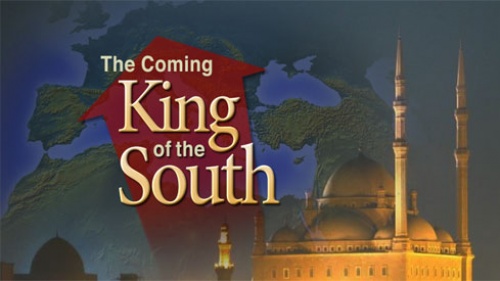
Now let’s read the prophecy in Daniel 11:40: “And at the time of the end shall the king of the south push at him: and the king of the north shall come against him like a whirlwind, with chariots, and with horsemen, and with many ships; and he shall enter into the countries, and shall overflow and pass over” (Daniel 11:40, emphasis added throughout).This tells us that “ at the time of the end” a king of the south will “push at” the king of the north. Who are these prophesied figures, and what does this mean?
The king of the South most likely will be a Muslim figure, since the lands to the south of Jerusalem are overwhelmingly Muslim and have been for centuries. As noted earlier, many Muslims desire and expect an Islamic messiah, the mahdi,or a new caliphto arise to unite Muslims in their struggle against the West. Either of these are likely possibilities.
The Arab world also has a history of populist leaders such as Saddam Hussein, Osama bin Laden and Muammar Gaddafi who saw themselves as leaders of the Arab or wider Muslim world.
Any such leader would naturally want to see Islam take over Europe, just as we are seeing now with massive Muslim immigration, high birth rates, and random violence and terror attacks to cow Europeans into submission.
Who is the end-time king of the North?
And who is the king of the North in this prophecy? Again, we need historical background to understand.Anciently, the lands of the kings of the North were absorbed into the Roman Empire. Other prophecies in Daniel chapters 2 and 7 describe a series of empires beginning in Daniel’s day and lasting until the time of the end of man’s self-rule on earth. History makes it clear that these were, in order, the Babylonian, Persian, Greek and Roman Empires.
These prophecies show that the last of these—the Roman Empire—exists in a resurrected form at the time of Jesus Christ’s return (Daniel 2:42-44; Daniel 7:23-27). While Muslims have dreamed for centuries of a united Islamic world, so too have Europeans longed for a unified European state. Some even describe their goal with the term “United States of Europe.”
In the centuries since the fall of the Roman Empire, various kings, emperors and despots openly proclaimed their desire to rebuild that dream. The current European Union (EU) was born of this desire decades ago, and it is a major economic power by any measure, rivaling America in important respects.
And Bible prophecy also reveals that a new European-centered superpower will become a reality—possibly as an outgrowth of the current European Union, which in its current form appears too politically weak and divided to continue indefinitely under its current pressures.
This new superpower is depicted prophetically in Revelation 17 as a creature with 10 horns representing an alliance of 10 leaders of nations or groups of nations who “give their power and authority” to another leader called “the beast” (Revelation 17:12-13).
The time setting for this is just before Jesus Christ’s return (Revelation 17:14), as this union “will make war with the Lamb.” The leader of this end-time superpower and the king of the North appear to be one and the same, as the king of the North also comes to his end in this same time frame—“the time of the end” (Daniel 11:40, Daniel 11:45).
Keys trends to watch
To sum up, this prophecy gives us the following keys to look for:• Efforts to unify the Muslim and/or Arab world under a single caliphate or leader.
• Continued efforts from the Islamic world to take over Europe via violence or migration or both.
• Shifts in European thinking toward anti-immigration leaders and parties, culminating in greater European unity and military and economic power—and ultimately in a coming military invasion of Egypt, Libya and Israel that sets the stage for a new world war that will threaten humanity with extinction.
We live in increasingly dangerous and sobering times. Those of us at Beyond Today are here to help you navigate these troubling waters. Continue reading Beyond Today so you can be better prepared for what lies ahead—and join us in praying to God always, “Your Kingdom come!”
You might also be interested in...

 United Church of God Pastor, Beyond Today Managing Editor
Scott Ashley is managing editor of Beyond Today magazine, United Church
of God booklets and its printed Bible Study Course. He and his wife,
Connie, live in Arvada, Colorado, a suburb of Denver.
United Church of God Pastor, Beyond Today Managing Editor
Scott Ashley is managing editor of Beyond Today magazine, United Church
of God booklets and its printed Bible Study Course. He and his wife,
Connie, live in Arvada, Colorado, a suburb of Denver.After graduating first in his high school class, Mr. Ashley attended Ambassador College in Big Sandy, Texas, graduating in 1976 with a theology major and minors in journalism and speech. It was there that he first became interested in publishing, an industry in which he has worked for more than 35 years.


