Showing posts with label Detroit. Show all posts

Tuesday, March 8, 2016

Lesson: Dealing With Unemployment

From http://el-paso.ucg.org/ or call 1-888-886-8632. Please follow this site here.

Hello friends! Welcome to this Bible study guide on "Dealing With Unemployment." With today's recession affecting the entire world, many people suddenly find themselves unemployed. What does God want us to do when we lose our job? Does the Bible even address this subject? Join me now as we see what the Bible says about this challenging situation.

Lesson: Dealing With Unemployment

Bible Study - Dealing With UnemploymentThe Bible shows that God Himself works, and He created mankind to work. Since God intends for us to be working, what does He want us to do when we lose our job? What does the Bible say about coping with the growing problem of unemployment?
A Christian from Georgia relates his story:
"Life was good working for a major automobile manufacturer. I found myself suddenly unemployed when I was fired because I kept God's Sabbath.
"I had one small child, and my wife was pregnant with our second. Money was now scarce, but the bills were plentiful. I prayed to God for help.
"The only job I could find was construction work. Pay was sporadic, and I was away from home a lot. More than once there was no food in the house for my expecting wife and young daughter. But God kept watch on us, as many times neighbors would bring food, or invite them over for breakfast or dinner.
"The construction work dried up, so I took a job with a recycling facility making barely above minimum wage. As grateful for the job as I was, the pay would not cover all my bills. I couldn't afford my car anymore. But once again, God came through. My supervisor discovered that I qualified for an apprentice program, which increased my pay by exactly one dollar more than my car payment!
"It was almost two years before I got my job back with the automobile manufacturer. But when I got my job back, I also received all of my back pay! Yes, during this trial God always took care of me and my family."
Share Your Story

What Does the Bible Say About Being Unemployed?

You may have experienced or know someone else who has gone through such difficult times. When some people lose a job, they find another job quickly. But for many, the dry spell between good jobs is long. Even when we pray for God's help, months and sometimes years can go by between jobs. Why does God allow that if He wants us to work?
As you study the Bible, you find that part of God's work is making better people out of us! God knows that trials can build good character in us. When we're unemployed, God can use that time to help us grow. So let's look at some relevant scriptures to show what we should be doing when we find ourselves unemployed.
Where is the first place you should go for help when you become unemployed?
Psalm 18:6
In my distress I called upon the Lord, and cried out to my God; He heard my voice from His temple, and my cry came before Him, even to His ears.
Hebrews 4:16
Let us therefore come boldly to the throne of grace, that we may obtain mercy and find grace to help in time of need.
When we find ourselves facing trials, the firstplace we should go for help is God. King David, a man after God's own heart, learned to look to God and depend on Him more than men. And the book of Hebrews encourages us to come boldly to God, even though we can feel beaten down by trials like unemployment.
Why should you turn to God for help?
1 Peter 5:7
…casting all your care upon Him, for He cares for you.
John 10:10
The thief does not come except to steal, and to kill, and to destroy. I have come that they may have life, and that they may have it more abundantly.
God is concerned about all of us. He wants each of us to have an abundant life and enjoy our work. Since God cares for us, we should turn to Him to help us in our time of need.
What attitude should you have while you're unemployed?
James 1:2-4
My brethren, count it all joy when you fall into various trials, knowing that the testing of your faith produces patience. But let patience have its perfect work, that you may be perfect and complete, lacking nothing.
Romans 5:3-4
And not only that, but we also glory in tribulations, knowing that tribulation produces perseverance; and perseverance, character; and character, hope.
Although it is totally against our human nature, we should be thankful for the opportunity to build character during this trial. If you approach this time with a positive attitude, you will grow and become a better person.
How did the patriarch Job react after he lost everything?
Job 1:21
And he said: "Naked I came from my mother's womb, and naked shall I return there. The Lord gave, and the Lord has taken away; blessed be the name of the Lord."
Job understood that God is in charge. He knew that all we have ultimately comes from God. Through his trial God made Job a better person, and afterwards blessed Job with twice as much as he had before (Job 42:10, 12)!
What does God expect you to be doing while you're unemployed?
Proverbs 13:4
The soul of a lazy man desires, and has nothing; but the soul of the diligent shall be made rich.
Proverbs 22:29
Do you see a man who excels in his work? He will stand before kings; he will not stand before unknown men.
Proverbs 15:22
Without counsel, plans go awry, but in the multitude of counselors they are established.
While we're out of work, God expects us to make a full-time job of finding a job. Study and seek advice about current job trends, ways to upgrade your skills and the best job search techniques. We need to be looking on the Internet and at classified ads, personally visiting company managers and networking with our friends and associates. Diligence gives you a huge advantage over those who are waiting for someone to come to them with a job.
What must you be doing to receive God's blessings?
Isaiah 59:1-2
Behold, the Lord's hand is not shortened, that it cannot save; nor His ear heavy, that it cannot hear. But your iniquities have separated you from your God; and your sins have hidden His face from you, so that He will not hear.
1 John 3:22
And whatever we ask we receive from Him, because we keep His commandments and do those things that are pleasing in His sight.
We must turn from sin and keep God's commandments to be blessed by Him. We can't expect God to bless us if we don't do what He says to do.
How will God help you find work?
Proverbs 3:5-6
Trust in the Lord with all your heart, and lean not on your own understanding; in all your ways acknowledge Him, and He shall direct your paths.
Much has been said and written about the power of networking to find jobs. God is the ultimate networker. He is more than capable of providing opportunities and opening doors for us. We must do our part and search diligently for work, yet we can trust in God to show us the way. Ask Him to provide the right opportunity.
How will God help you pay your bills while you're unemployed?
Psalm 23:1-6
The Lord is my shepherd; I shall not want. He makes me to lie down in green pastures; He leads me beside the still waters. He restores my soul; He leads me in the paths of righteousness For His name's sake. Yea, though I walk through the valley of the shadow of death, I will fear no evil; for You are with me; Your rod and Your staff, they comfort me. You prepare a table before me in the presence of my enemies; You anoint my head with oil; my cup runs over. Surely goodness and mercy shall follow me all the days of my life; and I will dwell in the house of the Lord forever.
Psalm 37:18-19
The Lord knows the days of the upright, and their inheritance shall be forever. They shall not be ashamed in the evil time, and in the days of famine they shall be satisfied.
1 Corinthians 10:13
No temptation has overtaken you except such as is common to man; but God is faithful, who will not allow you to be tempted beyond what you are able, but with the temptation will also make the way of escape, that you may be able to bear it.
While we work diligently to find a job and wait patiently on God to provide us permanent work, He is faithful to provide our daily needs. Whether there is famine of food or famine of work, God will provide. Even when it seems impossible to get by, God promises to miraculously intervene for those who obey Him. There was a widow who only had enough flour and oil for one more meal, yet God miraculously made that food last for many days—maybe a year or more (1 Kings 17:12-16).
What was King David's observation of those who live God's way and trust in Him?
Psalm 37:3-7, 25
Trust in the Lord, and do good; dwell in the land, and feed on His faithfulness. Delight yourself also in the Lord, and He shall give you the desires of your heart.
Commit your way to the Lord, trust also in Him, and He shall bring it to pass. He shall bring forth your righteousness as the light, and your justice as the noonday.
Rest in the Lord, and wait patiently for Him; do not fret because of him who prospers in his way, because of the man who brings wicked schemes to pass...
I have been young, and now am old; yet I have not seen the righteous forsaken, nor his descendants begging bread.
From a young child, King David knew God. And as an old man, he looked back and saw that those who did their best to obey God were always taken care of. Just like us, David went through hard times, but God never forsook him and was always there to take care of him. King David learned to trust in God. And if we trust and obey God, He promises to provide food and all our daily needs—in good times and bad (Matthew 6:25-33).

Apply Now

God wants to help you when you're unemployed. Go to Him first in prayer right now. Then make a plan to pray every day for His help in your job search. Diligently look for work and at the same time trust in Him to help provide you a job. You'll see the blessings that will follow!
Next Lesson: See the Bible Study Guides series menu for your choice of future lessons to study.
Questions about this lesson? Feedback about this lesson?
Related Resources:
Jump-Start Your Job Search
Financial Security and Peace of Mind from the booklet Making Life Work
Managing Your Finances
Planning Your Career: Part 1, Part 2, Part 3
Facing Hard Times With Brutal Optimism
Joy Is the Best Choice
Video: Keeping Your Job in a Bad Economy
Planning for Life: Part 1, Part 2, Part 3, Part 4

Friday, March 4, 2016

Teen Sex vs. Divine Light

From http://el-paso.ucg.org/ or call 1-888-886-8632. Please follow this site here.

In analyzing these questions, Time magazine writer Belinda Luscombe cites a litany of imprudent behavior by famous young ladies.
Girls behaving badly
Examples include recently published photos of a semi-clothed Miley Cyrus and the unwed pregnancies of Jamie Lynn Spears and Bristol Palin. Plus there are the “Gloucester Seventeen,” a group of high school girls in Massachusetts who agreed among themselves to get pregnant together.
Adding to real-life cases, the author cites fictitious young female personalities who behave just as badly—and often more explicitly. Characters from the television shows 90210 , Gossip Girl and The O.C. top the list, plus MTV hits like My Super Sweet 16 and Spring Break . Juno may be the most visible in a list of films that negatively influence teen girls.
There's not enough room in this commentary to fully address the ways in which this particular Time magazine article fails to properly handle the subject—but there is room to make two very important points.
Boy accountability
First, remember that Jamie Lynn Spears and Bristol Palin did not get pregnant by themselves, nor did the Gloucester Seventeen. Boys must be held accountable for immoral behavior just the same as girls.
Young men need to understand their proper role with young women—to respect their character and protect their purity. If a teenage guy wants to become a real man, he would never make sexual advances toward a girl or accept any advances that she might make toward him. Real men understand the value of saving themselves and their girlfriends for the incredible blessings of marriage.
Underestimating the media
Second, the Time writer fails to grasp the true danger of sexual content in modern media. She states that the link between how teen sexuality is portrayed in the media and the behavior of teen girls is “more complicated than Tracey see, Tracy do” (“The Truth About Teen Girls,” Sept. 22, 2008). That's a word play on “monkey see, monkey do” to describe how some imitate the actions of others without thinking.
While not every teen exposed to sexual content in news or entertainment apes the behavior he or she sees, that's no cause for the cold comfort implied by Ms. Luscombe. The problem with sexually suggestive or explicit material is that it fills the mind with images and sound bites that are incredibly difficult to un-see and un-hear.
Bright thinking vs. wrong sex
Jesus Christ said, “The lamp of the body is the eye. Therefore, when your eye is good, your whole body also is full of light. But when your eye is bad, your body also is full of darkness. Therefore take heed that the light which is in you is not darkness” (Luke 11:34-35).
Of greater concern than “Tracey see, Tracey do ” is the certainty that when Tracey sees, Tracey thinks . When you think about wrong behavior, you suffer a portion of the damaging consequences even if your thoughts never lead to actions. If wrong thoughts do lead to wrong actions, the damage suffered greatly increases.
Asking whether teen girls are becoming sexually active too early in life is the wrong question. Any young person, male or female, who engages in sexual activity before marriage is doing so too early!
The real question for a vertically thinking young person is, “What should I be thinking and how should I be acting so that I can save sex for my marriage?” Successfully answer this question and you'll never regret it! VT

You might also be interested in...

In a world that often devalues and dishonors women, where can a woman find...

Thursday, March 3, 2016

Current Events & Trends Detroit: only one of America's debt-ridden cities

From http://el-paso.ucg.org/ or call 1-888-886-8632. Please follow this site here.


At one time America's fourth most populous city hosting automakers General Motors, Ford and Chrysler, the Motor City has lost 63 percent of its population since 1950. Although there are some signs of renewal in its inner city, downward trends have been obvious for decades. Crime, government corruption, financial scandals plus dysfunctional family life have all played their role in Detroit's slide into bankruptcy.
But as The Economist recently pointed out beneath a recent headline: “It's not just Detroit . American cities and states must promise less or face disaster” (“America's Public Finances: The Unsteady States of America,” July 27, 2013).
The Financial Times added, “While Detroit is an extreme example of urban decay, its predicament sheds light on similar problems that afflict a number of US cities” (cover teaser for “Detroit: Descent Into Despair,” July 26).
Time magazine revealed that Birmingham, New Orleans and Philadelphia are among the foremost examples of cities with serious debt obligations in the millions (Aug. 5). Primary blame has been assigned to pensions, but society having gone awry in its fundamental relationships between people must figure heavily in such severe debt problems.
City governments wind up footing the costs of sin —both social and monetary. And ultimately, individual taxpayers and private business pick up the tab. As the Economist article concluded, “America's dynamic private sector is carrying on its back an unreformed Leviathan . Detroit is merely a symptom of that.” (Sources: The Economist, Financial Times, Time. )

You might also be interested in...

Wednesday, March 2, 2016

A Page on the World... Infidel

From http://el-paso.ucg.org/ or call 1-888-886-8632. Please follow this site here.

Infidel is a remarkable book by a remarkable person. It's unusual that someone less than 40 years old would have lived a life worthy of an autobiography, but Ayaan Hirsi Ali certainly has. You might not have heard or remembered her name, but you are likely aware of the brutal murder of filmmaker Theo van Gogh in November 2004 at the hands of a radical Muslim. Van Gogh produced an 11-minute documentary titled Submission about the inherent abuse of women in the Islamic faith.
We wrote of the murder and its implications in several articles in World News and Prophecy starting in December 2004. After shooting his victim, then cutting his throat nearly to decapitation, the assassin stabbed a note to van Gogh's chest. The note was a fatwa-like assassination order against the woman who wrote the screenplay—Ayaan Hirsi Ali.
Ali was, at the time, a member of the Dutch parliament. Little publicized outside of Holland, subsequent events threw the tiny nation into turmoil and eventually led Ali to write her extraordinary autobiography.
She now lives in the United States, but she came to Holland from Kenya, where she lived with her grandmother, mother and sister as refugees from war-torn Somalia. The family also lived for a time in Saudi Arabia and Ethiopia. She provides an insightful perception of the different approaches to Islam in the indigenous cultures and tribes.
Islam's oppression of women
Principally, Infidel is the story of Islam's effect upon women, told from the point of view of Somalis, where female circumcision is still practiced. Living in Saudi Arabia as a young girl in the 1970s, Ali also offers sharp insights into life as a woman under Islam in the Wahhabi tradition. In Kenya, as a teen, she was drawn to the radical Muslim Brotherhood, learning its violent philosophy from imams sponsored by Egypt and Saudi Arabia. She experienced and witnessed the routine beatings of women and children, as well as the facelessness of a female in the Islamic culture.
Yet, she did not rebel against her culture for a long time, not until her father arranged a marriage for her to a man she did not know and did not want to marry. Arranged marriages were—are—the norms in Islam. Her husband-to-be was Canadian, and while she was en route to Canada from Kenya to marry him, she sought asylum in Holland. She assimilated into the Dutch culture, as well as its politics, receiving a university education and eventually being elected to parliament.
Throughout it all, she struggled with her Muslim training, testing its assertions against what she witnessed in the West. She had been brought up to believe that only an Islamic government could produce a harmonious society, but she saw countries in Europe that were arguably better-ordered, cleaner and healthier than any of the Muslim nations in which she had lived. Moreover, the way the women of Europe were able to live was a universe away from Muslim practice.
She struggled with the Islamic mentality toward its women, concluding repeatedly that it did not fit the modern world. Even as a teen, she dared to question her imams, seeking the “why” behind the Koranic rules. As an adult, especially after moving to Holland, she openly debated those willing to address her questions. She could not find the relevancy within Islam that she believed the modern world requires. So she left the faith.
However, she did not leave her passionate desire to see the way of life for Muslim women improved. She grieved over the circumcision of young Somali girls that she knew continued even in the immigrant Somali communities of West. She had firsthand knowledge of it in Holland. (Female circumcision isn't a tenet of Islam, but the imams don't forbid it either. It's the remnant of an ignorant nomadic superstition.)
She describes as common throughout Islam the brutal subjugation of women, including arranged marriages, beatings by their husbands and the expectation that they will forever be quietly in the background of a male-dominated culture.
It is doubtful that she will bring about any change within Islam. Devout Muslims view her as a heretic; even her family cut off all contact with her. Ibrahim Hooper, spokesman for the Council on American-Islamic Relations, says Ali is “just another Muslim basher on the lecture circuit” (Neely Tucker, “True Believer,” Washington Post, March 7, 2007, p. C01).
Armed body guards travel with Ali wherever she goes; they have ever since the murder of van Gogh.
Three principal lessons
The book itself is excellent writing, moving quickly along through dynamic and tragic stories. There are three outstanding points to draw from it. The first is the insight into how shockingly different the cultures of Somalia, Ethiopia, Saudi Arabia and Kenya are from the West. Ali's grandmother literally lived in the Stone Age, married to a nomad and surviving off the desert; she was forced into an arranged marriage to an older man when she was 10 years old.
The second point springs from the first: That part of the world is still largely conscious of tribes, clans and families. The book opens with Ali's recitation of her ancestors, something that her grandmother had her do repeatedly. Whenever one met a stranger, the first thing they did was recite their family lines, usually to discover some common ancestor. Clans automatically helped fellow clan members with food, shelter or whatever else was needed.
When all else fails—as when Somalia overthrew its communist government—people return to their tribal identity. Sadly, that country exploded into intertribal warfare, propelling hundreds of thousands of refugees over the borders of neighboring countries.
Clearly, any international policies regarding the Middle East must be knowledgeable about tribal configurations, not merely national boundaries. Failing to fully understand and plan around this reality has frustrated the American-led coalition in Iraq.
The third point is the most important. It has to do with Ali's reaction to the 9/11 terror assault on the United States. When she heard of the attacks, her first reaction was, “Please don't let the attackers be Muslims.” Her worst fears were confirmed when she learned that that the terrorists were indeed Muslims. Ali bristled at the ignorance in analyses that claimed the attacks sprang from Islamic frustrations about Palestine, Israel or Western morals.
Terrorist attacks “were about belief”
“It was about belief,” she wrote, bluntly. Articles “about Islam being a religion of peace and tolerance, not the slightest bit violent…were fairy tales, nothing to do with the real world I knew…People theorized about poverty pushing people to terrorism; about colonialism and consumerism, pop culture and Western decadence… None of this pseudointellectualism had anything to do with reality” (p. 270).
Addressing the theory that American support for Israel and Arab frustration over Palestinian issues motivated the attacks, Ali scoffed that the attackers weren't Palestinian men. None left letters about Palestine. “This was belief, I thought. Not frustration, colonialism, or Israel: it was about a religious belief, a one-way ticket to Heaven” (ibid.).
Questions, doubts and challenges she had mentally collected about Islam now flooded Ali's mind. She wrote that she came to realize, “We froze the moral outlook of billions of people into the mind-set of the Arab desert in the seventh century” (p. 272).
She sees Islam as unwilling to bring the faith into the modern world. Equally, she sees the West as unwilling to perceive Islam for what it is. Commenting on a European Social Democrat Parties conference whose attendees “seemed to think it would be easy to set up the institutions for a European Islam in peace and harmony. They seemed clouded by wishful thinking rather than operating with rigorous analysis” (p. 278).
She was commenting on the fact that European Islamic communities are retaining their cultures, with their unacceptable and troublesome components. They are not integrating into Europe's culture, and they are retaining their deeply held religious convictions.
One of the changes she pushed for in Holland was the registration of “honor killings”—murders of Islamic women by family members over acts that they believe dishonored the family. Homicide statistics did not reflect this category until Ali lobbied the justice minister to try a pilot project in just two of the 25 regions in Holland. Monitoring honor killings revealed 11 in only seven months!
Such murders occur by the multiple thousands throughout the Muslim world, as well as within insular immigrant communities in Western countries. “Honor killings occur for a variety of offenses, including allegations of premarital or extramarital sex, refusing an arranged marriage, attempting to obtain a divorce, or simply talking with a man. If a woman brings shame to the family, her male relatives are bound by duty and culture to kill her” (James Emery, “Reputation Is Everything: Honor Killing Among the Palestinians,” www.worldandi.com, 2003).
The most explosive charge she leveled at Islam was in regard to the “marriage” of the prophet Muhammad, then in his 50s, to a 9-year-old girl. Ali pointed out to the Dutch authorities that he would be a pedophile by modern legal standards. Her comparison was a firebomb to devout Muslims.
You can understand why Ayaan Hirsi Ali has become a lightning rod for controversy in today's world. Islam and its internal struggles—Shia vs. Sunni, clan vs. clan, Wahhabism, radical terrorists, etc.—are all part of the daily news. All are part of the considerations of international politics, as well as global business. That reality makes Infidel worth reading.
As we have often observed in World News and Prophecy, the fomenting conflict between Islam and traditional Western nations and cultures is a natural fit to the end-time prophecies of a north-south pitched battle for control of the Middle East. We recommend our booklet The Middle East in Bible Prophecy for a complete analysis of those prophecies, as well as for an overview of the history of Islam. WNP

You might also be interested in...

Wednesday, June 17, 2015

Islamic Caliphate Declared What Does It Mean?

From http://el-paso.ucg.org/ or call 1-888-886-8632. Please follow this site here.

Islamic Caliphate Declared

What Does It Mean?

Login or Create an Account

With a UCG.org account you will be able to save items to read and study later!
Sign In | Sign Up
×
On the first day of the Muslim holy month of Ramadan this year, June 29, 2014, the al-Qaeda breakaway group ISIS or ISIL, the Islamic State of Iraq and al-Sham (i.e., Greater Syria or the Levant)—which has seized vast tracts of Iraq and much of northern Syria—formally declared the creation of an Islamic transnational state, or caliphate. In doing so, the group changed its name to just the Islamic State (IS), as the caliphate is to rule Muslims the world over.
The group's chief, who's borne the pseudonym Abu Bakr al-Baghdadi, was declared to be the new caliph or leader of the Islamic State—now Caliph Ibrahim. A spokesman for the group “called on those living in the areas under the organization's control to swear allegiance to al-Baghdadi and support him. 'The legality of all emirates, groups, states and organizations becomes null by the expansion of the caliph's authority and the arrival of its troops to their areas,' [the spokesman] said” (“ISIS Declares Creation of Mideast Caliphate Across Iraq and Syria,” CBS News, June 29, 2014).
Baghdadi then called for Muslims to rally to his new state and to conquering the Christian West, saying: “Those who can immigrate to the Islamic State should immigrate, as immigration to the house of Islam is a duty … Rush O Muslims to your state … This is my advice to you. If you hold to it you will conquer Rome and own the world, if Allah wills” (quoted by Damien McElroy, “Rome Will Be Conquered Next, Says Leader of 'Islamic State,'” The Telegraph, July 1, 2014).

Longtime desire to reestablish the caliphate

The desire to reestablish the caliphate is driven by the goal of joining all Muslims under a single rule—as in the days of Islam's founder, Muhammad, and his immediate successors or caliphs in the seventh century. Under that rule everyone is to strictly adhere to sharia—Islamic law and jurisprudence—and follow the way of jihad or holy war to conquer the globe.
The caliphate was declared by a succession of Muslim empires over the centuries, the latest being that of the Ottoman Turks, which ended with World War I. Yet these are viewed as corrupt, and the desire of the Islamists today is to restore the initial “righteous” caliphate.
Islamist terror groups the world over, including Hamas, al-Qaeda, Islamic Jihad, the Taliban, the Muslim Brotherhood, etc., “all profess the revival of the caliphate, the regime that was installed by Muhammed's righteous successors, the caliphs, and has become the iconic model to be emulated by all future generations of Muslims” (Raphael Israeli, From Arab Spring to Islamic Winter, 2013, p. xiii). (See “20-Year Plan for a Global Caliphate “.)
During and after the Arab Spring uprisings of 2011-2012, momentum seemed to be building toward the formation of a caliphate, particularly with the ascendance of a Muslim Brotherhood candidate, Mohamed Morsi, to the presidency of Egypt. Yet with the military coup in Egypt last year that ousted Morsi and instigated a major crackdown against the Brotherhood, the momentum toward a caliphate appeared to have stalled.
But now, with millions of Islamic extremists across the Middle East still pressing for that Muslim dream, where one door closes another opens (although the door in Egypt is by no means truly closed, as the population there remains predominantly Islamist).
So what are we to make of this new development?
A number of Islamist groups and prominent clerics are not supportive of the declaration of the Islamic State, as it's viewed as premature and a cause for infighting between Muslim groups and states. But significant support has come in from far quarters. No doubt a great deal of blood will be shed over this among Muslims and between Muslims and the non-Islamic world.
In considering the matter we should ask: How did the new Islamic State come to be, and what are its prospects for success as a revived caliphate? Or might another group receive wider acceptance in the role? And does Bible prophecy tell us anything regarding such developments?

The rise of ISIS and Abu Bakr al-Baghdadi

The al-Qaeda contingent in Iraq, headed up by Abu Musab al-Zarqawi in the mid-2000s, went through several incarnations before eventually becoming the Islamic State of Iraq, or ISI, which came to be headed up by Abu Bakr al-Baghdadi in 2010, when American forces were withdrawing from the country.
The group's extreme brutality and killing of fellow Muslims created a divide between it and al-Qaeda's international leadership, which considered Zarqawi and his followers too extreme and criticized them for alienating people from the Islamist cause.
Furthermore, Osama bin Laden's successor Ayman al-Zawahiri maintained, as do many Islamist scholars now opposed to the current caliphate declaration, that a caliphate must follow the purification of the wider Muslim world, being then based on the consent of the public.
But, as Margaret Coker explains in The Wall Street Journal, Baghdadi and his supporters “reject this doctrine of an evolving religious and social consensus. They believe instead that a pure Islamic regime can be more swiftly imposed by force” (“The New Jihad,” July 11).
And in fact, this is the way the caliphate has been imposed in past centuries.
The struggle came to a head in April 2013, when Baghdadi declared a takeover of the Nusra Front, an al-Qaeda-linked rebel militia fighting against President Bashar al-Assad in Syria, stating that it would be merged with ISI to form ISIS. The Nusra Front rejected the takeover bid and Zawahiri ordered Baghdadi to leave Syria and maintain operations in Iraq. But in a huge affront to al-Qaeda, Baghdadi said he would follow Allah instead and maintained the ISIS merger, whereupon Zawahiri formally disowned the group.
ISIS went on to take over sizable parts of Syria and Iraq, sweeping through in a brutal blitzkrieg. It took to social media to demoralize resistance by displaying its extreme brutality. This tactic helped ISIS to wrest control of the large city of Mosul and its environs in June of this year when the Iraqi army had to retreat due to massive numbers of desertions.
The conquest of this area put huge amounts of advanced U.S. weaponry into the hands of ISIS, as well as hundreds of millions of dollars looted from banks—making it far wealthier than al-Qaeda ever was. And with U.S. forces now gone from Iraq, the new Islamic State has a great deal of room to maneuver. It thus seems poised to change the Middle East, if not the greater world scene, in a dramatic fashion.

Striking fear in the hearts and minds of opponents

Joseph Farah, editor in chief of WND (the former WorldNetDaily), commented prior to the caliphate announcement: “Do I expect to see ISIS conquer the Middle East, North Africa, part of Europe and Asia in the 21st century? No, I don't. But I do expect to see enormous carnage and destruction and bloodshed as a result of this movement—far more, perhaps, than most other analysts project. There is a ferocity to ISIS that makes even al-Qaida uncomfortable. It has already captured more wealth and armaments, including chemical weapons, than all but a handful of countries in the world possess …
“Brutality difficult for Westerners to even imagine is the modus operandi of ISIS. It calls for a scorched-earth policy against its enemies—which includes Christians, Shiites, Alawites, Jews, non-believers and all non-Sunnis. ISIS leadership advocates and practices barbarism designed to strike fear into the hearts and minds of its opponents and anyone who doesn't stand with them in their strict Shariah Sunni code.
“Already the ISIS marauders have crucified victims, beheaded them and conducted mass executions of Iraqi soldiers and civilians. No atrocity is beneath them” (“ISIS Rising—What It Portends,” June 23, 2014).
Farah compares the speed of their conquest with the original march of Islam and even Alexander the Great. “The success of campaigns like that requires that superior forces faint in fear of the coming hordes. You can see it's working already in Iraq” (ibid.).

Is the new caliphate viable?

BBC security correspondent Frank Gardner gave a helpful analysis of the situation, dealing with the question of whether ISIS can maintain its rule and viability: “Analysts point out that seizing territory is one thing, governing it is quite another” (“'Jihadistan': Can Isis Militants Rule Seized Territory?” July 8, 2014).
Despite its remarkable military success in the wake of its psychological warfare, “Isis has effectively been 'punching above its weight,' to use a boxing analogy,” its numbers of between 10,000 and 15,000 fighters being low compared to competing forces. Gardner quotes a pan-Arab newspaper stating, “Isis' ability to control lands has been based on deals with local militants willing to do the 'ruling' for them.”
He further notes that Baghdadi and his followers do not seem, on one hand, to have learned from the mistakes of their predecessors under Zarqawi in Iraq in their brutal treatment of the populace, which failed to win hearts and minds. Regarding ISIS, “stories abound of harsh punishments imposed for the slightest of offences, women being confined to the home, public crucifixions, kidnappings and extortionate levies imposed on businesses …”
While Gardner on the other hand points out ISIS taking care of municipal needs like garbage collection, the mask of public service has since come off.
Gardner further states: “To succeed as a viable state, let alone as a transnational 'caliphate,' Isis will need access to oil and water.” And ISIS/IS now has both, controlling refineries and major dams in Syria and Iraq.
Gardner argues that the new Islamic state is not going away: “The only force capable of permanently ejecting Isis will be the tribes in those regions [they rule], and they have little incentive to do so while the Syrian civil war rages on …
“Which leaves the prospect of a violent, extremist, well-armed, well-funded and religiously intolerant militia becoming a permanent part of the Middle East landscape, a sort of de facto 'jihadistan.'” And, he notes, like Afghanistan it would also be a springboard for increased attacks against neighboring countries and the Western world.

Several key advantages and others to carry on the cause

In spite of the denunciation received from some Islamic scholars and disapproval from al-Qaeda and other jihadist organizations, this group nevertheless has much going for it in the Muslim world. One advantage is in the very declaration of the caliphate, as it's unlikely that a number of claimants would start declaring their own since that would minimize the whole idea of the pan-Islamic state.
Furthermore, the fact that ISIS/IS is actually carrying out major exploits and making massive gains, with the caliphate proclamation on top of that, can capture the imagination of the younger generation of jihadists.
As noted in Newsweek:“The brutal attacks of 9/11 were almost 13 years ago; many of the jihadist fighters on the front lines now were children then. They have grown up seeing Al-Qaeda on the defensive, with few successes of its own, while ISIS has stunned the world with its victories in Syria and Iraq” (Kurt Eichenwald, “Iraq's ISIS Is Eclipsing Al-Qaeda, Especially With Young Jihadists,” July 7, 2014).
Indeed, at his site Intelwire author J.M. Berger points out regarding al-Qaeda that “one of its few practical remaining plays would be to squander the entirety of whatever resources it has left on an attack against the West, in the hopes of regaining its reputation” (“A New Day for ISIS,” June 11). That should serve as a stark warning of great danger for the world even in the short term.
Since the proclamation of the new Islamic State, it has seen increasing voices of support by Islamists around the world. But even if the group falters in its bid to rule the broader Islamic nation, there are others who could still try to establish the caliphate.
There remains al-Qaeda of course. Then there's the Taliban in both Afghanistan and Pakistan—by which the caliphate potentially could acquire nuclear weapons. The Muslim Brotherhood still maintains a vast network of support in the Islamic world—and Egypt may yet eventually revert to rule by the Islamist majority, the economy there being presently in shambles. And Turkey's prime minister Recep Erdogan still dreams of a Turkish-led caliphate, as was the Ottoman Empire.
But with the caliphate already declared, a broad spectrum of Muslims from around the world may try to come together to help it succeed—and this could sway other Islamist leaders to support it. On the other hand, what some see as Baghdadi's big gamble in proclaiming the caliphate could backfire in a big way if things don't pan out for him. We will have to wait and see how matters develop.
As a preview of where things are headed, one of the first acts of the new caliphate was to issue a fatwa, or religious edict, ordering that “all women between the ages of 11 and 46 must undergo genital mutilation” (Agence France-Presse, July 24).
Again, it seems very likely that a lot of blood will flow because of the declared caliphate—both Muslims killing other Muslims and attacks being launched on non-Muslims.

Turning to the only reliable source for advance news

In the face of these events, if we want to know where the world is ultimately headed, we must turn to the only sure source of knowledge about the future—the Holy Bible, the very Word of God. Bible prophecy does seem to say, in Psalm 83, that a confederation of Middle Eastern peoples will come together with the intent of destroying Israel—apparently involving Arabs, Palestinians, Turks and others in the region.
Moreover, Daniel 11 refers to an end-time “king of the South” who will instigate a conflict with a power to the north—a revival of the Roman Empire centered in Europe—with the Holy Land caught in between.
Might the confederation and southern power in these prophecies be a restored caliphate? It seems quite likely. After all, the principal unifying factor among all these peoples is Islam—so a new Islamic empire bringing them together is not at all far-fetched.
Is the current Islamic State that power? Its leaders are so extreme that gaining a mass following among other Muslims poses a great challenge. Also, it does not yet encompass Egypt, which the southern power in Daniel 11 seems to include or even be based from. And perhaps the Islamic State won't reach that far in its current form.
Yet it could be that, just as the European Union of today seems to be the embryonic form of the coming European superpower, so the current Islamic State could be the embryonic form of a much greater caliphate to come. These developments certainly illustrate the desire of millions of Muslims to establish a caliphate.
Note again particularly the goal stated by the Islamic State to “conquer Rome and own the world.”It could well be that this long-held desire of Muslims will lead to the conditions described in the latter part of Daniel 11, where the end-time king of the South provokes the king of the North into an invasion of North Africa and the Middle East.
Momentous and dangerous times lie ahead. Stay alert and turn to God and His Word with all your heart. No matter what happens, He will see you through!
[ See the related article: 20-Year Plan for a Global Caliphate ]

Tuesday, June 16, 2015

Does the Koran Promote Peace and Cooperation?

From http://el-paso.ucg.org/ or call 1-888-886-8632. Please follow this site here.

Does the Koran Promote Peace and Cooperation?

Login or Create an Account

With a UCG.org account you will be able to save items to read and study later!
Sign In | Sign Up
×
All are quoted from the Dawood translation of the Koran.
• “Fight against them until idolatry [worship of any god other than Allah] is no more and [Allah's] religion [Islam] reigns supreme” (Sura 2:193).
• “Let those who would exchange the life of this world for the hereafter, fight for the cause of [Allah]; whoever fights for the cause of [Allah], whether he dies or triumphs, on him we shall bestow a rich recompense . . . The true believers fight for the cause of [Allah], but the infidels fight for the devil. Fight then against the friends of Satan” (Sura 4:74-76).
• “Those that make war against Allah and His apostle [Muhammad] and spread disorder in the land shall be slain or crucified or have their hands and feet cut off on alternate sides, or be banished from the land. They shall be held up to shame in this world and sternly punished in the hereafter” (Sura 5:33).
• “Believers, take neither Jews nor the Christians for your friends. They are friends with one another. Whoever of you seeks their friendship becomes one of their number. [Allah] does not guide the wrongdoers” (Sura 5:51).
• “[Allah] revealed His will to the angels, saying: 'I shall be with you. Give courage to the believers. I shall cast terror into the hearts of the infidels. Strike off their heads, strike off the very tips of their fingers!' That was because they defied [Allah] and His apostle [Muhammad]. He that defies [Allah] and His apostle shall be sternly punished by [Allah]” (Sura 8:12-13).
• “[Allah] will separate the wicked from the just. He will heap all the wicked [i.e. non-Muslims] one upon another and cast them into Hell. These will surely be the losers” (Sura 8:37).
• “Let not the unbelievers [non-Muslims] think that they will ever get away. Muster against them all the men and cavalry at your command, so that you may strike terror into the enemy of [Allah] and your enemy, and others besides them who are unknown to you but known to [Allah]” (Sura 8:59-60).
• “Prophet, rouse the faithful to arms. If there are twenty steadfast men among you, they shall vanquish two hundred; and if there are a hundred, they shall rout a thousand unbelievers, for they are devoid of understanding” (Sura 8:65).
• “A prophet may not take captives until he has fought and triumphed in the land” (Sura 8:67).
• “Make war on them. [Allah] will chastise them at your hands and humble them” (Sura 9:14).
• “Believers, why is it that when you are told: 'March in the cause of [Allah],' you linger slothfully in the land? Are you content with this life in preference to the life to come? Few indeed are the blessings of this life, compared with those of the life to come. If you do not go to war, He will punish you sternly, and will replace you by other men . . . March on and fight for the cause of [Allah], with your wealth and with your persons” (Sura 9:38-41).
• “Prophet, make war on the unbelievers and the hypocrites and deal rigorously with them. Hell shall be their home: an evil fate” (Sura 9:73).
• “They [faithful Muslims] will fight for the cause of [Allah], they will slay and be slain” (Sura 9:111).
• “Believers, make war on the infidels who dwell around you. Deal firmly with them. Know that [Allah] is with the righteous” (Sura 9:123).
• “When We resolve to raze a city, We first give warning to those of its people who live in comfort. If they persist in sin, judgment is irrevocably passed, and We destroy it utterly” (Sura 17:16).
• “We have destroyed many a sinful nation and replaced them by other men. And when they felt Our might they took to their heels and fled. They were told: 'Do not run away. Return to your comforts and to your dwellings. You shall be questioned all.' 'Woe betide us, we have done wrong' was their reply. And this they kept repeating until We mowed them down and put out their light” (Sura 21:11-15).
• “When you meet the unbelievers on the battlefield strike off their heads and, when you have laid them low, bind your captives firmly. Then grant them their freedom or take a ransom from them, until war shall lay down her burdens” (Sura 47:4).
• “Mohammed is [Allah's] apostle. Those who follow him are ruthless to the unbelievers but merciful to one another” (Sura 48:29).
• “It is He [Allah] who has sent forth His apostle [Muhammad] with guidance and the True Faith [Islam], so that he may exalt it above all religions, much as the idolaters [those who worship gods other than Allah] may dislike it” (Sura 61:9).

Wednesday, December 3, 2014

The Koran vs. The Bible

From http://el-paso.ucg.org/  or call 1-888-886-8632. Please follow this site here.


The Koran vs. The Bible


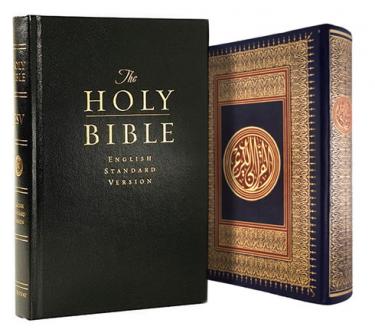
The messages that became the Koran, or Quran, make up a volume about four-fifths the size of the New Testament.

The Koran vs. The Bible
Source: iStockphoto
The Koran is divided into 114 chapters, or suras, which are arranged in order of decreasing length, with the exception of the brief first sura, which is part of a Muslim's daily prayer.
Muslims reject the Bible—and by extension, Christianity and Judaism—as being corrupt and superseded by the Koran. "Muslims regard the Old and New Testaments as sharing two defects from which the Quran is free ... They record only portions of the Truth ... [and] the Jewish and Christian Bibles were partially corrupted in transmission, a fact that explains the occasional discrepancies that occur between their accounts and parallel ones in the Quran ... The Quran [is] the final and infallible revelation of God's will. Its second chapter says explicitly: 'This is the Scripture whereof there is no doubt'" (John Miller and Aaron Kenedi, Inside Islam, 2002, p. 22).
"Muhammad was at political odds with the Christians when he had acquired a certain amount of supplementary information concerning Christian beliefs ... The Christians were wrong in saying that Jesus ... was the son of Allah ... There was only one God, Allah ... He [Jesus] was not God ... Islam, the last prophetic revelation, which had been granted to the Arabs, was therefore the supreme and definitive religion" (Maxime Rodinson, Muhammad, 1980, p. 240).
There are many conflicts between the Bible and various passages in the Koran. Sura 19:34-35 refers to Jesus as merely the son of Mary and denies that He was the Son of God. Sura 4:157 denies that Jesus was killed in the crucifixion, saying that it was another who looked like Him.
Sura 61:6 states: "Jesus son of Mary, ... said to the Israelites: 'I am sent forth to you from [Allah] to confirm the Torah already revealed, and to give news of an apostle that will come after me whose name is Ahmad [the Praised One]'"—the latter being a reference to Muhammad, whose name meant "Praiseworthy." Jesus is here presented as declaring Himself as merely the forerunner of the greater and final prophet Muhammad.
The Bible, of course, presents Jesus as the Son of God, the ultimate Prophet and the way to salvation. As Paul wrote, "There is one God and one Mediator between God and men, the Man Christ Jesus, who gave Himself a ransom for all, to be testified in due time" (1 Timothy:2:5-6).
Yet based on what the Koran states, "Muslims respect Jesus as one of perhaps 124,000 messengers or prophets Allah has sent, and one of the 25 listed in the Quran, but not as our Redeemer" (Marvin Olasky, "Islam vs. Liberty," World, Sept. 10, 2011).
Some branches of Islam teach that Jesus will return to earth—not as King of Kings and Lord of Lords, as the Bible teaches, but rather to accompany the mahdi, an Islamic messiah, and to convert the world, including Christians, to Islam by force.
Clearly, there is a stark contrast between the Holy Book of God and the revelation to Muhammad and teachings of Islam. And there cannot be two opposing revelations from the same God, as God cannot lie (Titus:1:2). Only one source is true—the Bible. For evidence of its trustworthiness, send for or download our free booklet Is the Bible True?


Thursday, September 11, 2014

Conflict Again in Iraq, Why It Matters

From http://el-paso.ucg.org/  or call 1-888-886-8632. Please follow this site here.


Conflict Again in Iraq, Why It Matters


Submitted June 12, 2014

Conflict Again in Iraq, Why It Matters
Source: Darwinek/Wikimedia Commons
It’s Sunni versus Shiite once again in Iraq and this time America is not around to keep the peace. How far will sectarian strife escalate during this round of fighting in this ancient region?
A group of Arab fighters calling themselves the Islamic State of Iraq (ISIS) have come back in force in northern Iraq and taken control of key cities of Tikrit and Mosul. Thought to have been weakened and out of the game, this group has had a resurgence of support in northern Iraq and eastern Syria. Coupled with the utter collapse of Iraqi forces in that region, their display of force over the past few days has created the largest threat to stability and security in Iraq since the American-led overthrow of Saddam Hussein’s government in 2003. Without American ground troops in the region, the fate of the country is uncertain. It appears that predictions of the Iraqi army's lack of preparedness, coupled with the political weakness of the country's leadership have come true. Tens of thousands of civilians fleeing their homes is the usual, and unfortunate, result of these conflicts.
This current conflict is on our mind: last week we recorded an episode of Beyond Today  to air close to the 100th anniversary of the beginning of World War I in August. We showed in the program how the current conflicts in the Middle East—and Iraq and Syria in particular—are a result of the decisions made in the aftermath of that war. The lines of the current Middle East nations were drawn during the Paris Peace Conference after the war. The lines dividing the countries did not always take into consideration the religious and ethnic differences. What we are seeing in today’s news out of the region is part of that story.
The problem is compounded today because of a vacuum of power created by America’s reluctance to police this failed region. America is going through a crisis of confidence in its role as the sole superpower in today’s world. The American-led invasion of Iraq in 2003 “broke” the fragile glue that held the nation together. Since having pulled out all troops, the country was left to police itself. Unfortunately, as this week’s events show, Iraq does not have a strong enough army and government to effectively maintain control.
Jesus Christ listed the rise of conflict among nations (nation shall rise agains nation) in Matthew:24:6 as one of the signs of the end of this present age. The word nation here is ethnos and more accurately refers to ethnic strife between the smaller grouping of peoples within larger nations. These intractable conflicts are what drag larger nations into war against one another.
Bible prophecy shows the Middle East will again drag larger nations into the region. What we are seeing in Iraq today shows us how this could be done in the future. That is why what is happening today in Iraq and Syria matters.