Showing posts with label Philadelphia. Show all posts

Tuesday, April 26, 2016

There's More Than a Crack on the Liberty Bell

From http://el-paso.ucg.org/ or call 1-888-886-8632. Please follow this site here.

The Fourth of July is coming up this week. This holiday honors a unique event in history. It's a commemoration of the time when men declared themselves free of the hereditary rule of other men and established a society not guided by right of birth, but guided by the privilege of individual freedom based on “the rights of life, liberty and the pursuit of happiness.”
July 4, 1776 began a new historical era in human relationships. Nothing would ever be the same again. History had reversed itself. Based on these tenets of individual liberty, the 13 colonies would ultimately emerge into becoming the Unites States of America, and would ultimately become the dominant nation on earth and the main exporter of the notion of political freedom.
Other than the Statue of Liberty in New York Harbor, there is perhaps no more revered icon of liberty in America that depicts “feelings of the Fourth” other than the Liberty Bell. Its claim on Americans' affections comes from the fact that its toll rallied the people of Philadelphia to the first public reading of the Declaration of Independence in front of Independence Hall on July 8, 1776. It was here that the common man would become attuned to his destiny. “Let freedom ring” is often associated with this single piece of molded iron.
But what about the familiar crack up the side of the bell? The bell has a notorious history of trial and error in its many moldings and later tollings, but it is commonly agreed that the final expansion of the crack, which would silence the “Bell of Freedom,” occurred on Washington’s Birthday in 1846. Now it is simply a monument for the ages.
But what other resonating message does this now dormant bell still tell us besides the exploits of the American Revolution and the faulty casting that ultimately led to its famous crack? Embedded into its iron fabric is an inscription from the biblical passage of Leviticus 25:10 which says, “Proclaim Liberty Throughout All the Land Unto All the Inhabitants.”
But why this phrase on this particular bell? It's best understood by opening up your Bible to the same scripture and focusing on the preceding thought of “And you shall consecrate the fiftieth year.”
The bell was commissioned to be crafted by the Pennsylvania Assembly to commemorate the 50-year anniversary of William Penn's 1701 Charter of Privileges. This progressive document, Pennsylvania’s first constitution, established broad freedoms regarding religious expression, a humane stance regarding Native Americans, and the inclusion of the citizenry in local government issues. Penn's genius of establishing new approaches to relationships in a New World was worthy of a golden anniversary memento.
But what liberty was being proclaimed in the original context of the scripture embedded next to the famous crack? And when was it proclaimed?
The preceding verse of Leviticus 25:9 states: “Then you shall cause the trumpet of the Jubilee to sound on the tenth day of the seventh month; on the Day of Atonement you shall make the trumpet sound throughout all the land.”
A reading of the entirety of Leviticus 25 will reveal to you that every 50 years at this time: 1) Families that had lost their land had it returned; 2) People who had become indentured servants due to economic conditions were released; and 3) In general, debts were forgiven. No wonder liberty was proclaimed “throughout the land” with the dawning of a new existence on the Day of Atonement.
Does this sound too good to be true? What is this Day of Atonement that is mentioned in verse 9? Does it have any relevance to our day? Or is it simply a cherished relic of the past, like the Liberty Bell, which has seen its best days come and gone?
Actually, it's a day whose meaning reveals and annually reminds Christians that we are truly free in Christ and that ultimately “the rulers of the darkness of this age” (Ephesians 6:12) will be cast aside on the trash heap of history on the ultimate independence day of the future.
Want to know more? Just click on to our Literature Library Section, then go to Booklets, and click on to God's Holy Day Plan: The Promise of Hope for All Mankind . The section on the Day of Atonement begins on page 38. It explains the future reality of how God is going to elevate all humanity to the ultimate rights of “life, liberty and the pursuit of happiness.”
Until then, we wish you a happy Fourth of July—and remember, there’s more than a crack on the bell.

You might also be interested in...

Tuesday, October 13, 2015

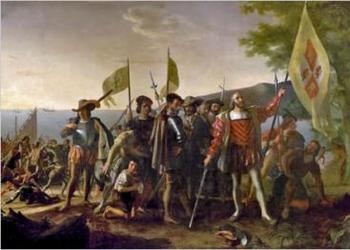
Christopher Columbus and Jesus Christ

From http://el-paso.ucg.org/ or call 1-888-886-8632. Please follow this site here.

Christopher Columbus and Jesus Christ

Login or Create an Account

With a UCG.org account you will be able to save items to read and study later!
Sign In | Sign Up
×
Notice what he later wrote in describing his efforts to find a new route to India:
“It was the Lord who put into my mind (I could feel his hand upon me) the fact that it would be possible to sail from here to the Indies. All who heard of my project rejected it with laughter, ridiculing me. There is no question that the inspiration was from the Holy Spirit . . .
“For the execution of the journey to the Indies, I did not make use of intelligence, mathematics or maps. It is simply the fulfillment of what Isaiah had prophesied . . . No one should fear to undertake any task in the name of our Savior if it is just and if the intention is purely for His holy service” (quoted by Bob Gingrich, Founding Fathers vs. History Revisionists: In Their Own Words, 2008, p. 17).

Friday, June 5, 2015

Hitler's Pope

From http://el-paso.ucg.org/ or call 1-888-886-8632. Please follow this site here.

Hitler's Pope

The Roman Church and the Third Reich

Login or Create an Account

With a UCG.org account you will be able to save items to read and study later!
Sign In | Sign Up
×
Hitler's Pope is a provocative title for a biography of Eugenio Pacelli, better known as Pope Pius XII. The implication in the title is that the pope was Hitler's enabler. The title is deliberate, the implication substantially proved by the author, British historian John Cornwell, a practicing Catholic who has fallen foul of the Vatican and other leading members of the hierarchy since publication of this revealing book by Viking.
Anybody who is familiar with Europe will be aware of the close historical links between church and state in the various European countries. France severed her ties in the anticlerical turmoil of the French Revolution toward the end of the 18th century. The 19th century wasn't good for the church either. With the theory of evolution, socialism and rapid industrialization, the church lost power and influence. Garibaldi's unification of Italy deprived the Roman Church of territory, while the subsequent unification of Germany under the Protestant Prussian kaisers led to the anti-Catholic policies of Chancellor Otto von Bismarck.
Desperate to reassert its authority, the Papacy reacted with the decree of papal infallibility in 1870, paving the way for increased centralization and papal authority. Six years later Eugenio Pacelli was born into a Roman legal family that had seen many years of service to the Holy See. Pacelli was destined to become perhaps the most autocratic of all popes, significantly shaping political events in the 20th century. His 19-year reign from 1939 to 1958 coincided with World War II and the division of Europe into the “Christian” West and the communist East that followed. Prior to becoming pope, he was Vatican secretary of state for 10 years, guiding the Vatican State's foreign policy.
Resurrections of Roman Empire
The biblical books of Daniel and Revelation predicted the church's involvement in European politics during the last 2,000 years (see principally Daniel 7 and Revelation 17). A church-state union was prophesied to be the foundation of seven successive attempts to reunify the Roman Empire.
It is relatively easy to look back in history and see the role of the church in the first few attempts to reunify Europe, to restore the glories of Imperial Rome, by uniting the various integral parts of the old Roman Empire. The first church-state union was under the Emperor Justinian who reunited the Empire in the middle of the sixth century. On Christmas Day 800, the pope himself crowned the Frankish King Charlemagne who attempted to restore the Western Empire. Less than two hundred years later the Holy Roman Empire was created to try to accomplish the same goal. Early in the 16th century when the Protestant Reformation posed a massive threat to the church, the Austrian Emperor Charles V and his son Philip II of Spain were strong defenders of the church-state bonds that had governed Europe for over one thousand years.
The next attempt to unite Europe was under the French Emperor Napoleon. The pope crowned him, too, but the revolution he brought to Europe was not favorable to the Papacy. Europe was entering an anti-religious age, which continues to this day.
The extent of the church's involvement in the resurrections of the Roman Empire already mentioned varied, but the church was always there, involved in some way. It has been more difficult to see the role of the church in the sixth attempt at European reunification, which culminated in two world wars that set Europe back decades and shattered the colonial empires of the European nations.
Author thought to clear pontiff's name
There have been many accusations made about Pius XII's involvement with the Third Reich. Growing up in England shortly after the Second World War, I recollect that most people were critical of the church for doing nothing to stop the war, or to help the Jewish victims of the Holocaust. It was generally believed that the Roman Church had been pro-Nazi, though there was a realization that many members of the church had not felt that way and many bravely helped the victims of Nazism.
With the beatification of Pius XII being considered, Cornwell wanted to completely clear the man's name and sought permission from the Vatican to research his career in the service of the Papacy, a career that spanned six decades, including the century's two greatest conflicts. Rather than exonerating Pius XII, Cornwell's research showed that the wartime pope was instrumental in helping the Nazis and that he acquiesced in the annihilation of six million Jews. Further research showed that Hitler's rise to absolute power may not have happened if not for Pacelli. Indeed, Pacelli directly contributed to both world wars. Without him, it is quite possible that neither conflict would have taken place.
The book is far from sensational. Rather, it takes us through Pacelli's life and the world events that involved the Vatican during those years.
Decree of infallibility
The Roman Catholic Church is a very conservative organization. Unlike any other church, it has sustained itself for almost 2,000 years, always actively involved in the world's politics, especially the politics of Europe. Church and state were inseparable. Right up into this century the Hapsburg emperors of Austria had the right to veto the choice of a pope. While the church taught its adherents the divine right of kings, the kings forced their people to be subject to the church in everything. The social order of Europe was built upon these two foundations.
When that order came to an end in the 19th century, the church had to reinvent and reassert itself. At a time of increasing democratization in many nations, the church became more autocratic. Faced with a republican mob in the Eternal City, Pius IX, crowned in 1846, “hurled denunciations against the 'outrageous treason of democracy' and threatened prospective voters with excommunication” ( Hitler's Pope, p. 10).
“The historic decree of papal infallibility passed on July 18, 1870, by 433 bishops, with only two against, reads as follows: 'The Roman Pontiff, when he speaks ex cathedra, that is, when, exercising the office of pastor and teacher of all Christians, he defines… A doctrine concerning faith and morals to be held by the whole Church, through the divine assistance promised to him in St. Peter, is possessed of that infallibility with which the Divine Redeemer wished his Church to be endowed… And therefore such definitions of the Roman Pontiff are irreformable of themselves, and not from the consent of the Church.'
“An additional decree proclaimed that the Pope had supreme jurisdiction over his bishops, individually and collectively. The Pope, in effect, was ultimately and unprecedentedly in charge” (p. 12).
“The Pope's Will: God's Will” was a popular expression at the time (p. 38).
One of Pacelli's successors, Pope Paul VI (1963-78), wrote in a private note to himself of the solitude that infallibility and the papal office resulted in. “I was solitary before, but now my solitariness becomes complete and awesome. Hence the dizziness, the vertigo. Like a statue on a plinth-that is how I live now. Jesus also was alone on the cross. I should not seek outside help to absolve me from my duty; my duty is too plain: decide, assume every responsibility for guiding others, even when it seems illogical and perhaps absurd. And to suffer alone… Me and God. The colloquy must be full and endless” (pp. 2-3).
No doubt similar sentiments would be expressed by subsequent popes. As Cornwell puts it: “The ideology of papal primacy, as we have known it within living memory, is an invention of the late 19th and early 20th centuries.”
It was this deeply held conviction of absolutism and of the supreme role of the church in the affairs of this world that led to Pacelli's controversial actions in the Nazi era. To Pacelli, nothing was more important than the Papacy. Even the lay members of the church were merely pawns in a great power game that was constantly being played out on the world stage. This becomes clear when reading of his role in both world wars.
Pius XII's role in the world wars
Just four days before the assassination of Austrian Archduke Franz Ferdinand in June 1914, representatives of the Vatican and the Serbian kingdom met to put their signatures to a treaty known as the “Serbian Concordat,” a document negotiated and drafted over the previous 18 months by Pacelli, then undersecretary of the Sacred Congregation for Extraordinary Affairs. This was a direct agreement between the Vatican and the Serbian authorities, members of the Orthodox faith.
“Within the terms of the treaty, Serbia guaranteed that the Holy See had the right to impose the new Code of Canon Law on its country's Catholic clergy and subjects; that Catholics would have freedom of religion, worship, and education within its territories… At the same time, the treaty implied the abrogation of the ancient protectorate rights of the Austro-Hungarian Empire over the Catholic enclaves in Serbia's territories.”
The treaty effectively cut Austria off from any influence in Serbia, a move that angered the Austrians at an extremely sensitive time. “The result was a sharp increase in anti-Serbian rhetoric and calls for action. When the archduke was murdered in Sarajevo only days later, emotions were already volatile. The 'Serbian Concordat' undoubtedly contributed to the uncompromising terms that the Austro-Hungarian Empire pressed on Serbia, making war inevitable” (pp. 48-49). Conflict between Austria and Serbia followed just a few weeks later, leading directly to World War I.
It wasn't that Pacelli had wanted war. It was rather that his single-minded obsession with the church and its own temporal power inadvertently caused a flare-up of tension between Austria and Serbia.
Less than 20 years later, as secretary of state, Pacelli again inadvertently contributed to the terrible events that led inevitably to the Second World War.
Hitler's rise to power was not an easy one. His first forced attempt at power resulted in his imprisonment, during which he wrote his book Mein Kampf (“My Struggle”). His National Socialist Party struggled on with minimal support as a small, bothersome party dwarfed by much bigger parties that held the reins of power. His opportunity for increased support came with the Depression when millions of Germans lost their jobs and hyper-inflation wiped out peoples' personal savings. Blaming the Jews and foreigners in general for causing this, Hitler's popularity rose. But he still could not command power without the support of others.
Eventually only the Catholic Center Party stood in his way to absolute power. Here Pacelli was very helpful. Seeking a concordat between the Reich and the Vatican, Pacelli betrayed the millions of Catholic supporters of the Catholic Center Party by signing an agreement with Hitler that resulted in a ban on political activity by members of the church. It was the only democratic party left in Germany. With its disbanding, Hitler became the supreme leader of the country. Nothing stood in his way. The Vatican had even become the first state to recognize his odious regime, giving it tacit approval by its “Reich Concordat.”
Role in Holocaust
Anti-Semitism has always been a problem in mainstream Christianity. The Roman Catholic Church is not the only culprit in this regard. But a long history of anti-Semitism in the church contributed to Pacelli's role in the Holocaust.
Cornwell writes: “Christian antipathy toward the Jews was born out of the belief, dating from the early Christian Church, that the Jews had murdered Christ-indeed, that they had murdered God. The Early Fathers of the Church, the great Christian writers of the first six centuries of Christianity, showed striking evidence of anti-Judaism. 'The blood of Jesus,' wrote Origen, 'falls not only on the Jews of that time, but on all generations of Jews up to the end of the world.' St. John Chrysostom wrote, 'The Synagogue is a brothel, a hiding place for unclean beasts… Never has any Jew prayed to God… They are possessed by demons.'
“At the First Council of Nicea in 325, the Emperor Constantine ordained that Easter should not compete with the Jewish Passover: 'It is unbecoming,' he declared, 'that on the holiest of festivals we should follow the customs of the Jews; henceforth let us have nothing in common with this odious people” (pp. 24-25).
Persecution became the norm for the Jews in “Christian” countries throughout the centuries that followed. The Holocaust is the persecution that resulted in the most deaths in the shortest possible time. But it was just one of many periods of intense persecution of Jews by Christians.
Cornwell's research revealed writings of Pacelli where he himself showed clearly his anti-Semitism. This would explain his role during the Holocaust. At a time when the whole world knew what was going on and he resided in the center of the capital of one of the two major European Axis powers, Pacelli did not use his influence to condemn the Holocaust, to call for the end to the persecution of the Jews. He could have at least done this one humanitarian act, but he didn't, which raises the question why. This question has been asked for six decades.
Cornwell wrote in the London Sunday Times:“Pacelli's failure to defend the Jews cannot be seen in isolation from the development of the ideology of papal authority. From the very outset of his career he had associated Judaism with the Bolshevist (communist) threat to destroy Christianity. But his antipathy towards Jews went much deeper. Writing in 1919 to a Vatican official from Munich, which had become the centre of local Bolshevik agitation, Pacelli had described the revolutionaries and their chief, Eugen Levien, in his headquarters in the former royal palace.
“'The building, once the home of a king, resounded with screams, vile language, profanities,' he wrote. 'In the midst of all this, a gang of young women, of dubious appearance, Jews like all the rest of them, hanging around in all the offices with lecherous demeanor and suggestive smiles. The boss of this female rabble was Levien's mistress: a young Russian woman, a Jew and a divorcee, who was in charge… This Levien is…also Russian and a Jew. Pale, dirty, with vacant eyes, hoarse voice, vulgar, repulsive, with a face that is both intelligent and sly.”
Like many, including Hitler, Pacelli equated Communism with the Jews.
A further extract from Cornwell's book shows that the Catholic Church was equated with the forces of extreme conservatism. “Catholicism appeared, on the face of it, to have links with the very right-wing nationalism, corporatism, and Fascism that sustained anti-Semitism or complicity in anti-Semitism on racial grounds. Practically every right-wing dictator of the period had been born and brought up a Catholic-notably Hitler, Horthy, Franco, Petain, Mussolini, Pavelic, and Tiso” (p. 280).
Pacelli wasn't just guilty of anti-Semitism. When the Allies entered Rome, he asked the American military commander of the city not to billet any “colored troops” there, out of concern for the city's women and children!
After World War II the whitewash began. The Papacy once more enjoys universal respect. Yet the factors that caused the problems highlighted in Cornwell's book persist to this day. History reminds us of the church's constant involvement in politics and of the disastrous consequences for millions of people. Prophecy reminds us that there is still one more resurrection of the church-state union that has dominated European civilization since the time of the Roman Empire.
Chillingly Cornwell wrote in the Sunday Times:“Liberal commentators insist that if Pius XII were to be canonized, he would join de Balaguer and Pius X-who was Pope while the young Pacelli wrote the laws establishing modern papal power-to form a formidable right-wing triumvirate of esteem. They would represent an endorsement through the next century of a centralized papal absolutism that proved disastrous for the Catholic church in Germany and, indeed, for the world as a whole.” WNP

Wednesday, May 20, 2015

Crisis in the Catholic Church

From http://el-paso.ucg.org/ or call 1-888-886-8632. Please follow this site here.

Crisis in the Catholic Church

  by Mario Seiglie 

Login or Create an Account

With a UCG.org account you will be able to save items to read and study later!
Sign In | Sign Up
×
Recent revelations have rocked the foundations of the Catholic Church. The news of sexual scandals in the Roman Church has filled the headlines and airwaves around the world. Numerous priests have been indicted for sexually abusing minors and many have ended in jail. These disclosures have weakened the American Catholic Church morally, financially and institutionally.
The U.S. Catholic Church isn't alone in the crisis. Numerous priests in Ireland, Australia, Poland, France and England have also been forced to resign or are facing prison sentences. “Scandals involving priests molesting children,” says The Los Angeles Times,“have hit parishes across America-and indeed, around the world-in recent decades. Thousands of adults have come forward to say they were abused as children and many priests have been sent to jail” (“Reports of Priest's Abuse Enrage Boston Catholics,” Feb. 9, 2002, p. 1).
Just in the United States, between 2,000 and 3,000 priests have been implicated for allegedly abusing children, and as of this writing, 60 clerics have been defrocked. The Catholic Church has reportedly paid more than $1 billion to the victims.
“The crisis gathers steam day after day,” says Time magazine, “with perhaps 2,000 priests accused of abuse across the country and hot lines jamming with more victims' calls… Since the first big abuse scandal broke at a Louisiana trial in 1985…an estimated $1 billion or more [has been paid by the Catholic Church]” (“Can the Church Be Saved?” April 1, 2002, p. 30).
Tom Economus, who heads the organization, “The Linkup-Survivors of Clergy Abuse,” himself a victim of priest sexual abuse, puts the figures even higher. He reports, “In the Roman Catholic Church there are over 800 priests [who] have been removed from ministry as a result of allegations against them… One noted expert claims that there are over 5,000 priests with some type of allegation against them. If this is true, then there are at least 1,000,000 direct victims of clergy sexual abuse and between 4-6 million indirect victims in the U.S.” (“Catholic Pedophile Priests: The Effects on U.S. Society,” TheLinkup.com Web site).
Although sexual abuse of minors is not confined to clerics of the Catholic Church, the sheer numbers of lawsuits against priests and the appalling number of children victimized place this scandal in a category of its own.
The start of the recent scandal
In January 2002, a particularly scandalous case involving a Boston priest who was accused of abusing children over a 30-year span triggered a national outcry. “The scandal erupted in January in Boston,” writes The Los Angeles Times, “when it was reported that a priest who had allegedly molested more than 140 children had been transferred by superiors from parish to parish” (“Mahony's Accuser Describes History of Mental Problems,” April 7, 2002, p. 28). The priest was found guilty, sentenced to nine years in jail, and the Boston archdiocese agreed to pay up to $30 million to 86 of the victims.
As a result of this case, many other victims of clerical abuse began talking to the civil authorities or the press. Just in the Boston area, Catholic officials were forced to turn in the names of another 88 priests who were accused of sexual misconduct with minors over the last 20 or more years. Now, an additional 400 complaints of sexual abuse in the area have turned up. Thomas Groome, a Boston College professor and a prominent Catholic, said, “This is our September 11.”
Pressure from insurance companies
Recently, the Boston archdiocese said it had settled so many child sexual abuse claims against it that a multimillion-dollar insurance fund was running dry. Insurance companies have threatened to cancel their coverage for such cases and this has prompted the Catholic leadership to step up its efforts to stem the tide of lawsuits.
In Ireland, the Catholic Church has sought an agreement with the government in an attempt to mitigate the legal damages, a somewhat similar situation to what tobacco companies have tried to do to protect themselves from lawsuits in the United States.
“In hopes of deterring class-action lawsuits,” reports The Los Angeles Times, “the church in January [2002] negotiated a compensation deal with the [Irish] government. Under the deal, thousands of people who were abused in church-run schools and orphanages from the 1950s onward would be eligible for hefty payments, but only if they dropped their own lawsuits. The church pledged to contribute about $110 million, mostly in property, to a government-run compensation board. The total payout is projected to run four times that” (“Irish Lawyer to Investigate Alleged Sex Abuse by Catholic Clergy,” April 5, 2002, p. 25).
An unintentional result of the current scandal has been to reveal the vast wealth of the Catholic Church, since it has been paying huge sums of money to the victims for decades, even though many of the funds are tied to confidentiality clauses.
“The fierce scrutiny that is piercing the Church's veil of secrecy over sex is also beginning to reveal the largely hidden state of its finances. As the institution's legal and moral crisis builds, so too do the threats to its economic foundation-a foundation already under enormous strain. Cases filed to date 'are just the tip of the iceberg, and it will be a multibillion-dollar problem before it ends,' says Roderick MacLeish Jr., a Boston attorney who has represented more than 100 victims in the past decade” (“The Economic Strain on the Church,” Business Week, April 15, 2002, p. 5).
The problem of celibacy
At the heart of the problem is the age-old issue of priestly celibacy, a mandatory practice of abstaining from marriage for all Catholic clerics that was adopted in A.D. 1139 at the Second Lateran Council.
Although Catholic Church leaders deny there is a direct connection between celibacy and priest sexual abuse of minors, serious studies done by priests or former priests claim there is a direct correlation.
Richard Sipe, a psychotherapist and a retired Benedictine monk who later married, conducted a 25-year study on the celibate practice of priests. He concluded back in 1995, “The Roman Catholic priesthood is in crisis. It is obvious that the crisis is sexual… The situation is far deeper and broader than most believers would like to admit, but a surprising number of church officials are aware of its true scope” ( Sex, Priests, and Power, 1995, p. 6).
How profound is the sexual crisis in the Roman Church? “In 1976,” adds Richard Sipe, “I was convinced that I had enough data to estimate that at any one time 6% of Catholic priests in the United States were having sex with minors. Since 1985 I have reviewed an additional 1,800 accusations by adults who claim that as children they were sexually abused by priests. I also have seen the histories of nearly 500 priests who are known to have abused. This further study convinces me that the celibate/sexual system as it exists fosters and produces, and will continue to produce, at a relatively stable rate, priests who sexually abuse minors…” (ibid., p. 27).
Although the news of child molestation by priests takes the headlines, the sexual problems among the Catholic clergy are far more rampant. “The sexual abuse of minors is only part of the problem” notes Sipe. “Four times as many priests involve themselves sexually with adult women, and twice the number of priests involve themselves with adult men” (ibid., p. 45).
Other experts who have studied the problem feel that Sipe's figures may be conservative and that the problem is not limited to the American priesthood. Gary Wills, a Pulitzer Prize winning author, writes, “The Jesuit sociologist Joseph Ficher credited an account of over 30% of German priests having affairs with women. Andrew Greeley says that 25% of priests under 35 are gay, half of them sexually active. Jason Berry reports seminarians telling him Greeley's numbers should be doubled [up to 50 percent]” ( Papal Sin, Structures of Deceit, 2000, p. 186).
Increasing number of homosexual priests
These figures highlight a growing trend as more homosexuals join the ranks of the Catholic priesthood.
“In some cases,” Gary Wills notes, “there have been reports of predominantly gay seminaries and homosexual climates within them that became so pronounced that heterosexual seminarians felt uncomfortable and ultimately left. Gays themselves register the change. In a survey of 101 gay priests, those ordained before 1960 remember their seminary as having been 51% gay. Those ordained after 1981 say their seminaries were 70% gay. The existence of such surveys is itself a sign of the altered condition of gays in the priesthood. Greater tolerance has made it possible to learn more about the existence and attitudes of gay priests, whose internal network was almost invisible to outsiders until recent decades…
“In fact, the admission of married men and women to the priesthood-which is bound to come anyway-may well come for the wrong reason, not because women and the community deserve this, but because of panic at the perception that the priesthood is becoming predominantly gay” (ibid., pp. 194-195).
Wills adds, “Almost all the priests who left in the massive hemorrhage of the 1970s and 1980s left to marry. The homosexual priests stayed, which meant that their proportion of the whole went up even when their absolute numbers stayed the same. And now even that absolute number is rising. Many observers suspect that John Paul's real legacy to his church is a gay priesthood” (ibid., p. 290).
Barriers that inhibit reporting
Why have reports of scandals been largely confined to the English-speaking world?
Much has to do with the more closed societies of the developing nations. Reporting such sexual abuse there is far more difficult than in the United States or Europe. “I should note here that in African, Latin, and South American cultures the 'priest's woman' and even married bishops seem to be taken for granted” (ibid., p. 72).
“The whole world has a problem,” according to Notre Dame Professor Robert Pelton, “but it gets brought into sharper perspective in the so-called First World. In Latin America, it's more difficult to challenge the Catholic Church, and so many people will say they're more worried about their next meal and these types of concerns” (“U.S. View of Scandal Not Shared by World,” The Boston Globe, April 8, 2002, p. 1).
The Boston Globe article goes on to say, “A Providence College psychology professor, the Rev. Joseph J. Guido, conducted a survey of superiors of an unspecified Catholic religious order and found that 83 percent of the North Americans were aware of an accusation of abuse against one of their priests, compared with 43 percent in Central America and the Caribbean and one-third in Africa, Asia, Europe, and South America.
“'Research suggests…that the sexual abuse of children is a problem for the church everywhere,' Guido wrote in the current issue of America magazine, a Jesuit weekly. 'However,' he wrote, 'outside North America the religious order superiors were more likely to be aware of sexual misconduct by priests with adults, rather than children. In several parts of the English-speaking world, clergy sexual abuse scandals have erupted over the last two decades, costing the church hundreds of millions of dollars and immeasurable goodwill.'”
Problem can no longer be covered up
Why did it take so long to uncover what was going on?
“The Roman Catholic Church,” explains Time magazine, “is a stern hierarchy that has always kept its deliberations secret, policed itself and issued orders from the top. An obedient priest moves up in power by keeping his head down, winning rewards for bureaucratic skills and strict orthodoxy… If allegations came to diocese attention, the bishop, a power unto himself who often operated as if ordination gave him a share of the Pope's infallibility, acted as prosecutor, judge, sentencer. Desperate to retain even sinful men, as the number of priests shrank alarmingly, and ever putting the image of the Church first, bishops refined the system. Convince the family that publicity would harm the faith. Don't report to the police; don't warn the parish… And if a victim finally sued, the strategy was to admit nothing, buy silence, settle out of court and seal the deal with a confidentiality contract” (“Can the Church Be Saved?” April 1, 2002, p. 31).
Presently, the four-month-long sexual scandal has been so serious that the pope ordered all U.S. cardinals to appear before him in an attempt to stem the swelling tide of bad publicity. In a follow-up statement to the meetings, the pontiff said, “The abuse of the young is a grave symptom of a crisis affecting not only the Church but society as a whole. It is a deep-seated crisis of sexual morality, even of human relationships, and its prime victims are the family and the young. In addressing the problem of abuse with clarity and determination, the Church will help society to understand and deal with the crisis in its midst.”
“The church stopped short of developing a 'zero tolerance' policy for priests accused of sexual transgressions. The American church leaders said they would recommend a special process to defrock any priest who has become 'notorious and is guilty of the serial, predatory sexual abuse of minors.' In cases that are 'not notorious' they would leave it up to the local bishop to decide if such a priest is a threat to children and should be defrocked” (Associated Press, April 24, 2002).
At the very least, this crisis will force the American segment of the Catholic Church to take stricter measures with errant priests and provide better, more open, cooperation with authorities to deal with violations of civil law. Both will be significant changes in the heretofore cloistered world of the Catholic hierarchy. WNP

Wednesday, January 28, 2015

Auschwitz: 70 Years Later

From http://el-paso.ucg.org/  or call 1-888-886-8632. Please follow this site here.


Auschwitz: 70 Years Later


A survivor called this death camp "the world's biggest cemetery". Do we remember and have we learned the lessons?


Media Download Options [ Download Media: right-click on link ]
filesVideo
MP4 Video
Video
MP4 Video - Low Quality
Audio
MP3 Audio - Auschwitz: 70 Years Later


[Darris McNeely] You see the sign over the entrance to this camp? It says, “Arbeit macht frei” – “Work makes free”. It’s the deceptive sign, famous, over the entrance to the German concentration camp in Warsaw called Auschwitz. Today (January 27, 2015) marks the 70th anniversary that Russian troops entered the camp and liberated the surviving Jewish members of this particular death camp which is one of the most famous of the many that the Nazi Germans conducted during World War II and the infamous Holocaust, where more than six million Jews lost their lives during that time. World leaders are gathered there today. Yesterday, many survivors came in and were there, and many for the first time coming back into that camp since they were teenagers and barely survived with their lives in the horror of what was taking place at that particular time.
Auschwitz, by one, was called “the world’s biggest cemetery”, because of the thousands and thousands of people who died there in crematoriums. It’s a sobering situation. Those who went back yesterday certainly did go back wanting not only to revisit where they were in their youth, but to also make a point that the world should not forget, and that they should remember what took place there. And that is very interesting because we don’t want to forget – for many, many reasons – the evils that were perpetrated upon a group of people during this particular period of time. It’s particularly important to remember because right now in Europe, with terrorist threats that have been taking place, especially in France, and other events – the specter of anti-Semitism has once again reared its ugly head in Europe. In fact, some are saying that in France today, it is the most unsafe spot in Europe for Jews because of attacks on synagogues, and Jews in particular, even as recently as a few weeks ago with the Islamic terrorist attacks upon the French newspaper, that a day later also included an attack upon a Jewish market and people being killed there. And so it is very unsafe and that attention is being drawn to the problem of anti-Semitism from many different quarters against Jews in Europe and other parts of the world, as well. The problem has not gone away. And so it is true that while this particular event, the Holocaust of World War II, should be remembered, never forgotten, we should also remember that the world has moved on a lot since then. And frankly, in some parts of the world, the lessons have not been learned. And this is not remembered in the same way that I’m trying to do it here with this particular Daily. There is still evil, there is still hatred against Jews and against other ethnic groups of people, and the evil that mankind can know has not yet stopped.
I also have a particular interest in this because I recognize some of the roots of anti-Semitism being far deeper than just against a group of people. The hatred that is expressed historically against Jews also reflects a hatred against God, and any who would try to worship God in spirit and in truth, according to the Scriptures. And when I say that it hasn’t been forgotten, it’s because I read a scripture such as Revelation:12:17, where it shows a time in the future prophetically where the powerful spiritual forces of evil that unleashed this particular Holocaust and other holocausts of history will once again be unleashed against those who seek to keep the commandments of God and the testimony of Jesus Christ. And that’s sobering because that transcends any ethnic group. That transcends the – that comes to the people of God. And that’s important as we recognize what the scripture tells us and what the nature of evil is as it is inspired by powerful, evil spiritual forces in this world today.
So let’s remember this particular event, the Holocaust of World War II, seventieth anniversary of Auschwitz, but let it also remind us of something deeper in terms of the costs that are there, as we obey God and we worship Him in spirit and in truth today.
That’s BT Daily . Join us next time.
Nobody has commented yet. Be the first to kick off the discussion!
Login/Register to post comments


Tuesday, January 27, 2015

This Is the Way... A Walk In the Snow: Character Counts In a Nation's Leaders

From http://el-paso.ucg.org/  or call 1-888-886-8632. Please follow this site here.


This Is the Way... A Walk In the Snow: Character Counts In a Nation's Leaders


Printer-friendly version


Today, during and after the recent impeachment hearings and trial, there is talk of "compartmentalization"—the notion that all the parts of one's life do not necessarily have to connect, that moral character and job competency do not have to be in one man. This is simply not the original American equation of republican ideal and it is certainly not biblically founded.

Historical episodes are much like a snowfield. Someone has to go first through the dual challenge of wonderment and danger. There comes a time in the human experience in which people, tribes and nations are confronted with this proverbial field of snow. I would like to share with you one man's walk in the snow on behalf of his nation. But before I do, let's understand who lays the field before us.
Long ago, God stated to Abraham that, "in you all the families of the earth shall be blessed"(Genesis:12:3). It is to be understood that first and foremost this is speaking of spiritual salvation for all humanity through the birth of Abraham's descendant, Jesus Christ. But there is also an added aspect of historical note regarding the physical descendants of Abraham that should be considered. It is found in Genesis:48:19. In speaking of Abraham's grandchildren, the Bible says, "He also shall become a people, and he also shall be great; but truly his younger brother shall be greater than he, and his descendants shall become a multitude of nations."
This verse spells out a prophetic blessing upon Abraham's descendants that defines a role of historical greatness.These verses speak of a people who would become "great" and a kindred people who would become a "multitude of nations." We see spelled out verses that depict the modern rise of the special relationship communities of the United States (Manasseh) and the famous alliance of nations known as the British Commonwealth (Ephraim).
But greatness does not just occur. God utilizes men and women throughout human history to bring about His will and purpose. God intervenes in the human chronicle through the hearts and minds of people. Romans:13:1 exemplifies God's finger on the pulse of history by stating, "For there is no authority except from God, and the authorities that exist are appointed by God."
Throughout the biblical narrative we think of Pharaoh, Nebuchadnezzar, Cyrus, Tiberius and Herod. What about George Washington? No, he is not biblically mentioned by name, but can we consider that he was directly used by God? Was he "appointed" by God to a role in His plan of establishing the "greatness" of modern day Manasseh? A "greatness" that would be molded by his personal walk through the historical fresh snow laid before him at the dawn of the American Revolution? Let's peek back in history and understand the tracks that Washington laid for future generations to follow.
The Man Behind the Picture
Today, many people when confronted with George Washington, think of the man with the stern face painted by Gilbert Stuart that appears on America's one dollar bills. As a landed gentleman, he would become first a general and later the first president of the United States. This is indeed a limiting picture, and to limit Washington is to limit ourselves. Rather than being stuck with the visual picture of the colonnades of Mt. Vernon, let's understand that Washington was born in humbler surroundings, being born into a much lower rung of Virginia gentry. We might say towards the bottom.
At his father's early death, in accordance with the British custom, most of the inheritance of family domain went to his half-brother Lawrence. Washington's formal education was over at age 15. But he did an amazing thing. He wrote out a collection of European maxims which he titled "The Rules of Civility and Decent Behavior in Company and Conversation." This exercise would instill in him a moral fabric in relating to other human beings. It would be his shining star to guide him. This is not too unlike the writing exercise the ancient kings of Israel were to perform. The instruction of Deuteronomy:17:18-20 states, "Also it shall be, when he sits on the throne of his kingdom, that he shall write for himself a copy of this law in a book, from the one before the priests, the Levites. And it shall be with him, and he shall read it all the days of his life, that he may learn to fear the Lord his God and be careful to observe all the words of this law and these statutes, that his heart may not be lifted above his brethren, that he may not turn aside from the commandment to the right hand or to the left, and that he may prolong his days in his kingdom, he and his children in the midst of Israel."
God's law was more than just rules for rules' sake, but more about relationships. Relationships that would not separate men, but bring them together on the equal plane of "brethren." Washington's list is in no way holy writ, but it contains a lot of wisdom pertaining to personal dealings with others. Let's read a few of the rules he wrote:
"In the presence of others, sing not to yourself with a humming noise, nor drum with your fingers or feet." "Sleep not when others speak, sit not when others stand, speak not when you should hold your peace, walk not on when others stop." My favorite is, "Spit not in the fire, nor stoop low before it, neither put your hands into the flames to warm them, nor set your feet upon the fire especially if there be meat before it."
What is interesting is the sense of value placed on outgoing concern towards others. These "proverbs" of the classical era would offer Washington a sensitized moral compass of "justice, judgment and equity;" as mentioned in the Bible and offer "to the young man knowledge and discretion-A wise man will hear and increase learning"(Proverbs:1:4-5). At a time when colonial America was still inventing itself, this young man was likewise self-examining and personally inventive. He recognized that if he were to succeed and be a person of worth he would have to establish standards and values. Values that would work later in life for him-recognizing that you do not find your values in a trial or situation, but you take them into the arena with you. The common self invention of the man and the nation would cross paths on the snow field of history 40 years down the line.
Prepared For Future Battles
As a young man, Washington had burning ambition and a self-importance that moved him through the ranks of the colonial militia. His time spent in the French and Indian War would both prepare him for future battle and place a curb on his ego, as he experienced both triumph and failure. After the war, he married well, having taken Martha Custis to wife. At the outbreak of the Revolutionary War, he became commander of the Continental Army. As an interesting part of focused leadership, he had the Declaration of Independence read aloud to every soldier so that he might know what was at stake.
This would be very important in the bumpy road to independence from the British Empire. Early on, he would be chased from Brooklyn, lose Manhattan, flee across New Jersey, and pick up a couple of victories at Princeton and Trenton. But always his biggest victory would be keeping the army together. Imagine an army composed of merchants, farmers, backwoodsmen, including every ethnic and racial group in America (still in some cases speaking their native tongue), all from 13 different sovereign states. Yankees from New England, Dutch from New York, Germans from Pennsylvania, Scots-Irish from the South, Swedes from Delaware, and African-Americans seeking a piece of the dream for liberty .
But all this would come to a grinding halt in the snows of Valley Forge, Pennsylvania, in the winter of 1777. Washington despaired, "The game will be pretty well up!" The British General Howe was outside Philadelphia, Congress had fled to Baltimore, and there before him in the snow was the sight of "men, without clothes, to cover their nakedness; without blankets to lay on; without shoes, by which their marches might be traced, by the blood from their feet." His army had shrunk to 3,000 men, and more were deserting daily. What had happened to that bright and wondrous picture of liberty? What had happened to the pure and glistening wonderment of government not based upon birth, but government based upon personal ability?
Like the snow, Washington now had to step out and make tracks where no man had gone before. Encouragement would come from a young, French nobleman, the Marquis de Lafayette. It is said that at one particularly low point the Marquis reminded his general that "the eyes of Europe are upon you!" Every step was being watched, every footprint in the snow was being analyzed by a world which had never known anything other than kings, emperors, czars and khans. Proverbs:29:18 says, "Where there is no vision, the people perish." Sometimes we need to remind one another exactly "why are we here?" In his book The Seven Habits of Highly Effective People, Steven Covey calls it "beginning with the end in mind." Herbert Armstrong called it "keeping the big picture." Remember, you don't find your values in a trial, you take them in with you. First Corinthians 3:13 vividly reminds us, "Each one's work will become clear: for the Day will declare it, because it will be revealed by fire; and the fire will test each one's work, of what sort it is."
The Most Famous Man in the World
The "greatness factor" of this one man's personal walk through the snow was yet to come a few years down the line. It came in 1783. The war was won and the long drawn-out peace accord was finally ratified. What Washington did next would astound the world. He simply got off his horse and went home to his beloved Mt. Vernon. This made him the most famous man in the world. The greatest victory he accomplished was letting go of power. This had rarely been done before. The snow was fresh and Washington carefully and surely laid a great print for others to follow. He was the modern day Cincinnatus, the Latin farmer of Roman lore. According to history as it comes down to us, Cincinnatus had victoriously defended Rome against her enemies at her gate and was invited to become ruler. But, he went back to his farm saying only that he had done his duty. What would you have done?
In English history, having disposed of King Charles, Oliver Cromwell stayed on his horse at the head of the New Model Army and became Lord Protector. Napoleon a few years down the line would stay on his horse and go from being "first citizen of the republic" to Emperor. In the course of the American Revolution as sole commander, Washington had outlasted eight presidents of the Continental Congress. On December 23, 1783, at Annapolis, Maryland, Washington ceremoniously handed back to the president of Congress the parchment commission he had received in Philadelphia on June 15, 1775. He had never lost the vision. For this man, giving up power was more ennobling than winning a war. It is said that King George III asked the American painter Benjamin West what General Washington was likely to do when peace came. Would he stay with the army, would he become head of state? West replied, "Washington will probably return home to his farm." King George responded, "If Washington does that, he will become the most famous man in the world."
Rather than merely comparing Washington's example to Cincinnatus, let's focus on Christ's words in Matthew:20:25-28. "But Jesus called them to Himself and said, "You know that the rulers of the Gentiles lord it over them, and those who are great exercise authority over them. Yet it shall not be so among you; but whoever desires to become great among you, let him be your servant. And whoever desires to be first among you, let him be your slave-just as the Son of Man did not come to be served, but to serve, and to give His life a ransom for many."
Whether or not Washington fully recognized it, he was following someone else's tracks that had been laid out long before his.
For the remainder of his life, George Washington realized he would have incredible responsibility in how he conducted himself and used his fame and notoriety. He would be called on again and again to "walk through the snow." In 1785, two years after the final peace treaty had been signed, with the country tottering in its disunited infancy under the Articles of Confederation, he stated, "I can foresee no evil greater than disunion." Here were 13 loosely confederated states of America now more afraid of one another than the nearby lingering shadow of the British Empire. How could they ever unite? As he would state, "the fate of unborn millions" would rest on their deliberations. Here was an individual of growth and invention that would spend his life in transformation from a British subject, to a man of the South from Virginia, to a Nationalist.
Character Does Count
But as all the wrinkles were slowly ironed away at Philadelphia's Constitutional Convention, a lingering nerve of contention remained before the delegates. Having cast off (in Colonial eyes) a tyrant, would they ever again dare invest authority in an executive power? Washington's powerful life example spoke louder than any good arguments. It would not be by his grasp for power or intellectual wit that he would ascend to the presidency—but simply by "quiet tracks in the snow" laid over a lifetime.
Pierce Butler, of South Carolina, thought the president's powers were "full, great, and greater than I was disposed to make them. Nor do I believe they would have been so great had not many of the members cast their eyes towards General Washington as President; and shaped their ideas of the Powers to be given a President by their opinions of his virtue." From the beginning America's concept of the presidency, was the idea of virtue—let's put it plainly—character. The standard would be—not simply what you do—but what you are. This was the only way a young and frightened nation could come to terms with trusting an executive leader. Washington's lifetime of self invention based upon his "Rules of Civility" had served him and the nation well.
Today, during and after the recent impeachment hearings and trial, there is talk of "compartmentalization"—the notion that all the parts of one's life do not necessarily have to connect, that moral character and job competency do not have to be in one man. This is simply not the original American equation of republican ideal and it is certainly not biblically founded. Notice the power of cause and effect as outlined in Proverbs:29:2: "When the righteous are in authority, the people rejoice, but when a wicked man rules, the people groan."
Washington's stepping off his horse, and later his stepping away from the executive office after his second term, set forever the mode of America's greatness of being gallant enough to conquer the problems that lay in her path, but also to have the ability to muster the "right stuff" and go back home when the task was accomplished.
Snow is a wondrous attraction. So are the revolutions of history. What appears wondrous can take a sharp turn towards disaster. Many revolutions would follow the American experiment. Hope would turn to despair as tyrants of royal blood would be replaced with demagogues with radical blood flowing in their veins. Much of Latin America would devolve for nearly two centuries into military dictatorships. The great revolutions of France and Russia would go through stages of moderation to radicalism-ending with much of their citizenry losing their lives, because of the lack of a galvanizing example of moderation like Washington's. Imagine a "modern day Manasseh" whose civilians would report to the military or whose chief executive maintained total power for a lifetime. Then, think again of one man's influence as he walked in the snow for a nation to follow. WNP
Nobody has commented yet. Be the first to kick off the discussion!
Login/Register to post comments